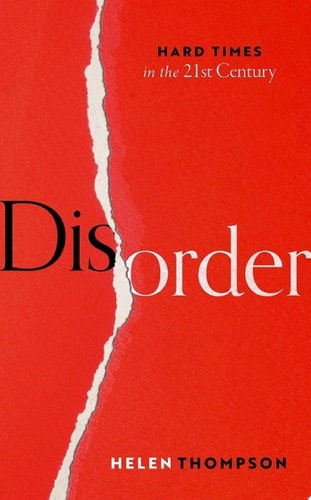
Disorder: Hard Times in the 21st Century
0
0
As an Amazon Associate and affiliate partner, Menrva Books earns from qualifying purchases. Learn more
Author Description
Getting to grips with the overlapping geopolitical, economic, and political crises faced by Western democratic societies in the 2020s.The 21st century has brought a powerful tide of geopolitical, economic, and democratic shocks. Their fallout has led central banks to create over $25 trillion of new money, brought about a new age of geopolitical competition, destabilised the Middle East, ruptured the European Union, and exposed old political fault lines in the United States.Disorder: Hard Times in the 21st Century is a long history of this present political moment. It recounts three histories - one about geopolitics, one about the world economy, and one about western democracies - and explains how in the years of political disorder prior to the pandemic the disruption in each became one big story. It shows how much of this turbulence originated in problems generated by fossil-fuel energies, and it explains why as the green transition takes place the long-standing predicaments energy invariably shapes will remain in place.The Afterword brings these geopolitical, economic, and political crises up to date by reflecting on the development and impact of the war in Ukraine.
Menrva's Summary
THE THESIS
How did the convergence of geopolitical, economic, and democratic crises create the systemic instability observed in Western societies during the 21st century? Helen Thompson, a professor of political economy, synthesizes historical data regarding energy markets, monetary policy, and democratic governance to argue that these disparate crises are interconnected. She posits that the reliance on fossil fuels has acted as a primary driver for global turbulence, suggesting that these structural issues will persist even as the world attempts a transition to green energy.
THE SCOPE MAP
What You Will Find
- Analysis of the intersection between fossil fuel dependency and global political instability
- A historical account of central bank monetary expansion exceeding $25 trillion
- Examination of political fault lines within the United States and the European Union
- An updated assessment of the geopolitical impact of the war in Ukraine
Scope Limits
- The text does not provide a prescriptive policy manual for resolving these crises
- It does not offer a detailed technical roadmap for the mechanics of the green energy transition
THE AUTHORITY PERSPECTIVE
Experts and political analysts frequently cite this work for its comprehensive integration of economic and geopolitical history. Readers often note the dense, analytical nature of the prose, which requires a foundational understanding of modern political history to fully grasp the author's arguments.
Page Count:
383
Publication Date:
2022-01-01
Publisher:
OUP Oxford
ISBN-10:
0192634216
ISBN-13:
9780192634214
History
Economics
International relations
Geopolitics
Special Topics
Energy policy
Community Tags
Similar Books