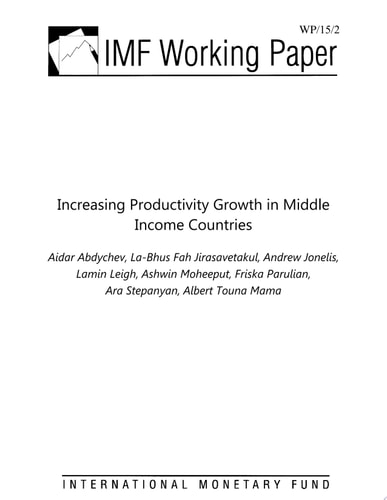
Increasing Productivity Growth in Middle Income Countries
0
0
As an Amazon Associate and affiliate partner, Menrva Books earns from qualifying purchases. Learn more
Author Description
Many small middle-income countries (SMICs) in sub-Saharan Africa (SSA) have experienced a moderation in growth in recent years. Although factor accumulation, most notably capital deepening, was crucial to the success of many SMICs historically, this growth model appears to have run its course. The analysis in this paper suggests that the decline in the contribution of total factor productivity (TFP) to growth is largely responsible for the slowdown in trend growth in many SMICs, which highlights the need for policy actions to reinvigorate productivity growth. This paper explores the question of what kind of structural policies could boost productivity growth in SMICs and the political economy factors that may be contributing to the slow implementation of these critical reforms in these countries. The findings suggest that although macroeconomic stability and trade openness are necessary for productivity growth, they are not sufficient. SMICs need to improve the quality of their public spending, most notably in education to minimize the skill mismatch in the labor market, reduce the regulatory burden on firms, improve access to finance by small and medium-sized enterprises and create the enabling environment to facilitate structural transformation in these economies.
Menrva's Summary
THE THESIS
This paper investigates the causes and potential solutions for the slowdown in productivity growth experienced by many small middle-income countries in Sub-Saharan Africa. The analysis suggests that a decline in total factor productivity (TFP) is the primary driver of this trend, necessitating policy interventions to reverse it. The authors explore structural policies that could invigorate productivity and the political economy challenges hindering reform implementation, focusing on improving public spending, education, regulatory environments, and access to finance.
THE SCOPE MAP
- Analysis of growth moderation in small middle-income countries (SMICs) in Sub-Saharan Africa.
- Identification of declining Total Factor Productivity (TFP) as a key factor in growth slowdown.
- Exploration of structural policies to boost productivity growth.
- Examination of political economy factors affecting reform implementation.
- Recommendations for improving the quality of public spending, particularly in education.
- Strategies to reduce the regulatory burden on firms.
- Measures to enhance access to finance for small and medium-sized enterprises (SMEs).
- Discussion on creating an enabling environment for structural transformation in economies.
THE AUTHORITY PERSPECTIVE
The analysis presented in this paper highlights the critical need for policy actions to reinvigorate productivity growth in small middle-income countries, particularly in Sub-Saharan Africa. It posits that while macroeconomic stability and trade openness are foundational, they are insufficient on their own. The paper emphasizes the importance of improving public spending quality, especially in education, to address skill mismatches, alongside reducing regulatory burdens and enhancing SME access to finance to foster structural transformation. The findings suggest a multi-faceted approach is required to overcome the challenges of moderating growth in these economies.
Page Count:
29
Publication Date:
2015-01-13
Publisher:
International Monetary Fund
ISBN-10:
1475547188
ISBN-13:
9781475547184
Economics
Non-Fiction
Public Policy
Community Tags
Similar Books