The New Global Trading Order
0
0
As an Amazon Associate and affiliate partner, Menrva Books earns from qualifying purchases. Learn more
Author Description
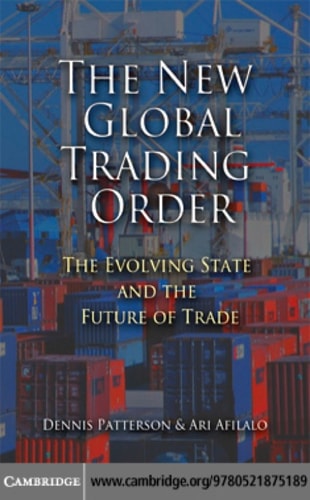
The international institutions that have governed global trade since the end of World War II have lost their effectiveness, and global trade governance is fractured. The need for new institutions is obvious, and yet, few proposals seem to be on offer. The key to understanding the global trading order lies in uncovering the relationship between trade and the State, and how the inner constitution of Statecraft drives the architecture of the global order and requires structural changes as the State traverses successive cycles. The current trade order, focused on the liberalization of trade in goods and services and the management of related issues, is predicated on policies and practices that were the product of a global trading order of the 20th-century modern nation-states. Today, a new form of the State - the post-modern State - is evolving. In this book, the authors propose a new trade norm - the enablement of global economic opportunity - and a new institution - the Trade Council - to overhaul the global trading order.
Menrva's Summary
THE THESIS
The existing global trade institutions are failing, necessitating a new framework for international commerce. The authors argue that the effectiveness of post-WWII trade governance has waned due to its foundation in 20th-century nation-states, which are now evolving into a new
THE SCOPE MAP
- Analysis of the relationship between trade and the State, and how Statecraft influences global trade architecture.
- Examination of the evolution from modern nation-states to the emerging "post-modern State".
- Proposal for a new trade norm: the enablement of global economic opportunity.
- Proposal for a new institution: the Trade Council, to reform the global trading order.
THE AUTHORITY PERSPECTIVE
The book addresses the evident decline in the effectiveness of international institutions governing global trade since World War II. It posits that the current trade order, built upon policies from the era of modern nation-states, is becoming obsolete as a new "post-modern State" emerges. The authors propose a new framework, including a "Trade Council" and a norm of "enablement of global economic opportunity," to restructure global trade governance. This work is likely to appeal to academics and policymakers interested in international economics and political theory.
Page Count:
256
Publication Date:
2008-03-31
Publisher:
Cambridge University Press
ISBN-10:
0511474008
ISBN-13:
9780511474002
Politics
Economics
Non-Fiction
International relations
Community Tags
Similar Books