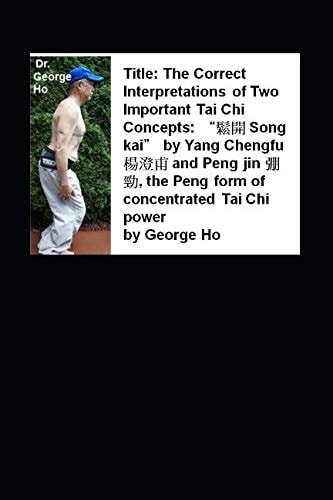
The Correct Interpretations of Two Important Tai Chi Concepts: Song Kai by Yang Chengfu and Peng Jin, the Peng Form of Concentrated Tai Chi Power, The CranioSacral Postural Reflex of Taiji
0
0
As an Amazon Associate and affiliate partner, Menrva Books earns from qualifying purchases. Learn more
Author Description
This booklet starts with the detailed explanations of two inadequately translated concepts. The first one is Master Yang Chengfu''s " Song kai", which has been inadequately translated as "relaxed or relaxation". The second one is the Peng form of concentrated Tai Chi power, called Peng jin in Chinese. It has been inadequately translated as "warding off". Another common mistake is the use of the Chinese character, for. According to the Kāngxī zìdiǎn, the most authoritative Chinese dictionary, (the wrong Chinese character for Peng) is pronounced as bīng. As a noun it means an arrow quiver ( ); as a verb, it means covering the arrow quiver with a hand ". (the right Chinese character for Peng) is pronounced as péng. It describes the appearance of a strong bow (; it also means full ( ). This obvious mistake has persisted for several decades and even now I have encountered people telling me that they are afraid to change the use of because it was taught to him by a very famous Tai Chi teacher. To me the dominance of traditionalism and the commercialization of Tai Chi have been haunting its development as a form of Dong gong that complements Jing gong in the Daoist and the Buddhist practices for Enlightenment and Longevity. The basic foundation techniques for these exercises are not difficult to learn and not difficult to master. They are definitely not those commonly seen esthetic but complicated moves that appear in competitions like in the Olympics. According to a famous Chan (Zen in Japanese) master, Master Nan Huai-jin the principles of Tai Chi can be applied into our daily living, called the Sì wēiyí (the four dignified modes of daily activities i.e. walking, standing, sitting and meditating in a lying down posture): Xíng (walking), zhù (standing), zuò (sitting), wò (meditating in a lying down posture). They are a lot easier to learn than any style of Tai Chi. I have published two books on walking and swimming. One book is called, "Meditation Bliss and
Menrva's Summary
THE THESIS
This book clarifies the precise meanings of two fundamental Tai Chi concepts that have been widely mistranslated. The text addresses Master Yang Chengfu's
THE SCOPE MAP
- Detailed explanation of "Song kai" and its mistranslation as "relaxed or relaxation".
- Analysis of the "Peng jin" form of concentrated Tai Chi power and its mistranslation as "warding off".
- Examination of the incorrect use of the Chinese character "
- Discussion of the authoritative Kāngxī zìdiǎn's definitions for both characters.
- Critique of traditionalism and commercialization hindering Tai Chi's development as a complementary practice for Enlightenment and Longevity.
- Introduction to the basic foundation techniques of Tai Chi, emphasizing their simplicity compared to aesthetic competition moves.
- Application of Tai Chi principles to daily living, known as the Sì wēiyí (walking, standing, sitting, meditating in a lying down posture), as described by Master Nan Huai-jin.
- Reference to the authors' previous publications on walking and swimming.
THE AUTHORITY PERSPECTIVE
This work aims to correct long-standing mistranslations within Tai Chi terminology, specifically focusing on "Song kai" and "Peng jin". It delves into the etymological and semantic distinctions between the correct and incorrect Chinese characters used, drawing upon authoritative dictionaries and the teachings of prominent figures like Master Yang Chengfu and Master Nan Huai-jin. The authors argue that a deeper, more accurate understanding of these concepts is crucial for Tai Chi's development as a practice that complements spiritual disciplines and promotes longevity, contrasting it with overly aestheticized competitive forms. The text suggests that the core principles of Tai Chi are accessible and applicable to daily life through practices like walking, standing, sitting, and meditating.
Page Count:
111
Publication Date:
2019-02-15
Publisher:
Independently Published
ISBN-10:
1796972010
ISBN-13:
9781796972016
Philosophy
Health
Non-Fiction
Tai Chi
Martial Arts
Eastern Philosophy
Wellness
Community Tags
Similar Books
Reader Comments
Share Your Thoughts
No comments yet. Be the first to share your thoughts!