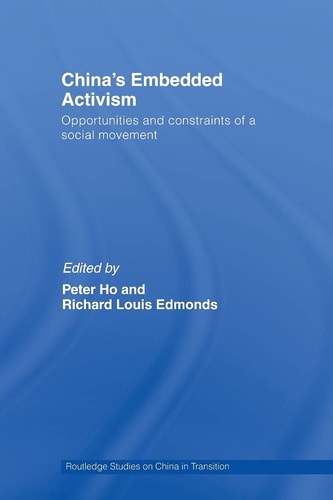
China's Embedded Activism: Opportunities and Constraints of a Social Movement
0
0
As an Amazon Associate and affiliate partner, Menrva Books earns from qualifying purchases. Learn more
Author Description
In recent years China has been remarkable in achieving extraordinary economic transformation, yet without fundamental political change. To many observers this would seem to imply a weakness in Chinese civil society. However, though the idea of democracy as multitudes of citizens taking to the streets may be attractive, it is simultaneously misleading as it disregards the nature of political change taking place in China today: a gradual shift towards a polity adapted to a pluralist society. At the same time, one may wonder what the limited political space implies for the development of a social movement in China. This book explores this question by focusing on one of the most active areas of Chinese civil society: the environment. China's Embedded Activism argues that China's semi-authoritarian limitations on the freedom of association and speech, coupled with increased social spaces for civic action has created a milieu in which activism occurs in an embedded fashion. The semi-authoritarian atmosphere is restrictive of, but paradoxically, also conducive to nationwide, collective action with less risk of social instability and repression at the hand of the governing elite. Rich in case studies about environmental civic organizations in China, and written by a team of international experts on social movements, NGOs, democratization, and civil society, this book addresses a wide readership of students, scholars and professionals interested in development, geography and environment, political change, and contemporary Chinese society.
Menrva's Summary
THE THESIS
This book investigates the complex relationship between China's rapid economic development and the constraints and opportunities for social movements within its semi-authoritarian political system. It argues that despite limitations on freedom of association and speech, the Chinese polity is adapting to a pluralist society, creating a unique environment for activism. The book focuses on environmental civic organizations as a key case study, exploring how activism becomes 'embedded' within this context, paradoxically fostering collective action while mitigating risks of instability and repression.
THE SCOPE MAP
- Analysis of China's semi-authoritarian political system and its impact on civil society.
- Exploration of the concept of 'embedded activism' in the Chinese context.
- Detailed case studies of environmental civic organizations in China.
- Discussion of the opportunities and constraints faced by social movements in China.
- Examination of the balance between social activism and political stability.
- Insights into the gradual shift towards a polity adapted to a pluralist society.
THE AUTHORITY PERSPECTIVE
This book is recognized for its nuanced examination of social movements within China's unique political landscape. It is noted for its focus on environmental activism as a prime example of 'embedded activism,' where state limitations paradoxically create space for collective action. The work is appreciated for its rich case studies and the expertise of its international contributors, offering valuable insights for students, scholars, and professionals interested in Chinese society, development, and political change.
Page Count:
288
Publication Date:
2012-03-22
Publisher:
Routledge
ISBN-10:
0415512689
ISBN-13:
9780415512688
History
Politics
Non-Fiction
China Studies
Civil society
Community Tags
Other Editions(4)

Similar Books







Reader Comments
Share Your Thoughts
No comments yet. Be the first to share your thoughts!