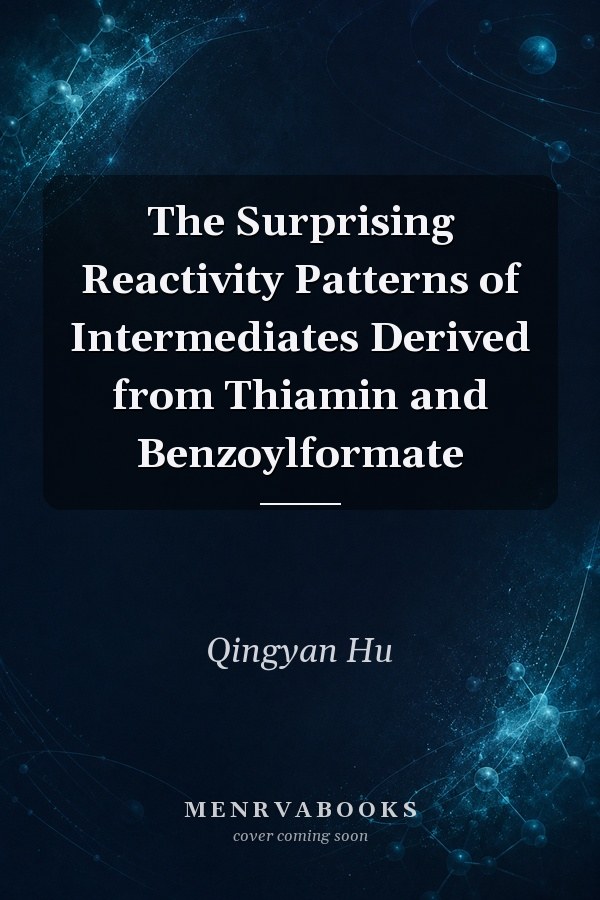
The Surprising Reactivity Patterns of Intermediates Derived from Thiamin and Benzoylformate
0
0
As an Amazon Associate and affiliate partner, Menrva Books earns from qualifying purchases. Learn more
Author Description
The conversion of benzoylformate to benzaldehyde and carbon dioxide is catalyzed by benzoylformate decarboxylase (BFD), an enzyme that utilizes thiamin diphosphate (TDP) as a cofactor. There is no reaction at all in the absence of the enzyme.*We synthesized alpha-mandelyl-thiamin (MT), a species whose inherent reactivity should be very close to that of the intermediate formed on the enzyme. This precisely separates the role of the protein and cofactor in catalysis. We identified several important distinctions: (1) Decarboxylation of MT produces 2-1-(hydroxybenzyl)thiamin (HBnT) in competition with fragmentation products (that destroy thiamin). The enzyme avoids the fragmentation process. (2) The decarboxylation of MT is slower (by about 106) than kcat of BFD. The protein accelerates what appears to be a unimolecular process. (3) Fragmentation of the decarboxylation product of MT is several orders of magnitude faster than k cat of BFD. The enzyme avoids the faster process. A likely mechanism would be the result of stereoelectronic effects. (4) Protonation of the pyrimidine of MT, as modeled by N1'-methylation, has no effect on the competition between fragmentation and protonation products. Therefore, charge on the pyrimidine does not control product distribution. (5) Bronsted acid catalysts in general promote formation of HBnT over fragmentation, but do not accelerate decarboxylation. However, protonated pyridines accelerate the decarboxylation. Since there is no role for an acid in breaking the C-C bond, it is likely that the acid is trapping the intermediate in competition with a reverse reaction (CO2 addition). Thus, the reactions of the intermediates are clearly controlled by the protein. Based on the results in the thesis, we conclude that primary function of TDP is to serve as a point of covalent attachment, electrostatic stabilization of transition states, and specific orientation within the protein that controls reactivity and access to protein side chain cat
Menrva's Summary
THE THESIS
This work investigates the reactivity patterns of intermediates derived from thiamin and benzoylformate, specifically focusing on the role of the enzyme benzoylformate decarboxylase (BFD) and its cofactor thiamin diphosphate (TDP) in catalysis. The research synthesizes alpha-mandelyl-thiamin (MT) to mimic the enzyme-bound intermediate, thereby isolating the protein's influence from the cofactor's inherent properties. Through this synthesis and subsequent analysis, the study aims to elucidate the precise mechanisms by which the enzyme controls reactivity, accelerates decarboxylation, and prevents fragmentation of thiamin.
THE SCOPE MAP
- Synthesis and characterization of alpha-mandelyl-thiamin (MT) as a model for enzyme-bound intermediates.
- Comparative analysis of MT decarboxylation versus enzyme-catalyzed decarboxylation by BFD.
- Identification of fragmentation pathways and the enzyme's role in suppressing them.
- Investigation into the kinetic differences between uncatalyzed and enzyme-catalyzed reactions.
- Exploration of the influence of protonation and acid catalysis on product distribution and reaction rates.
- Mechanistic proposals, including stereoelectronic effects, to explain the observed reactivity control by the protein.
- Discussion on the primary functions of TDP within the enzyme's active site: covalent attachment, electrostatic stabilization, and orientation.
THE AUTHORITY PERSPECTIVE
This research presents a detailed biochemical and chemical analysis of thiamin-derived intermediates, offering insights into enzymatic catalysis. The study's methodical approach, separating the roles of the cofactor and protein, provides a clear framework for understanding how enzymes achieve specificity and efficiency. The findings suggest that the protein environment is critical for controlling reaction pathways and rates, particularly in preventing destructive fragmentation. The work is likely to be of interest to researchers in enzymology, organic chemistry, and biochemistry.
Page Count:
218
Publication Date:
2006-01-01
Publisher:
Library and Archives Canada = Bibliothèque et Archives Canada
ISBN-10:
049415750X
ISBN-13:
9780494157503
Science
Non-Fiction
Biochemistry
Organic chemistry
Scientific Research
Enzymology
Community Tags
Similar Books





Reader Comments
Share Your Thoughts
No comments yet. Be the first to share your thoughts!