
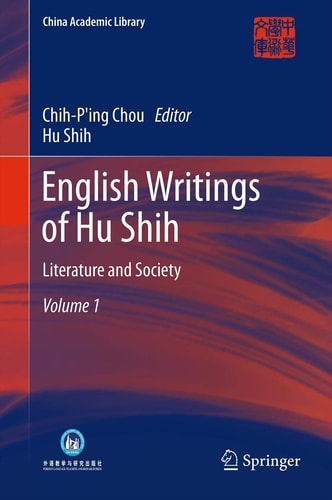
English Writings of Hu Shih: Chinese Philosophy and Intellectual History
0
0
As an Amazon Associate and affiliate partner, Menrva Books earns from qualifying purchases. Learn more
Author Description
Hu Shih (1891-1962),. In the 1910s, Hu studied at Cornell University and later Columbia University, both in the United States. At Columbia, he was greatly influenced by his professor, John Dewey, and became a lifelong advocate of pragmatic evolutionary change. He received his Ph.D. in Philosophy in 1917 and returned to lecture at Peking University. Hu soon became one of the leading and most influential intellectuals during the May Fourth Movement and later the New Culture Movement. His most widely recognized achievement during this period was as a key contributor to Chinese liberalism and language reform in his advocacy for the use of written vernacular Chinese. Hu Shih was the Republic of China’s Ambassador to the United States of America (1938-1942) and later Chancellor of Peking University (1946-1948). In 1939 Hu Shih was nominated for a Nobel Prize in literature and in 1958 became president of the “Academia Sinica” in Taiwan, where he remained until his death in Nangang at the age of 71. This diverse collection brings together his English essays, speeches and academic papers, as well as book reviews, all written between 1919 and 1962. English Writings of Hu Shih represents his thinking and insights on such topics as scientific methodology, liberalism and democracy, and social problems. It can also serve as a helpful resource for those who study Hu Shih and his views on ancient and modern China. The first volume “Chinese Philosophy and Intellectual History” allows readers to trace the development of Chinese thought and see the historical methodology applied therein. The second volume “Literature and Society” mainly includes Hu Shih’s works on language reform, which owing to his advocacy for the use of written vernacular Chinese were a success in both the educational and literary fields. The third volume “National Crisis and Public Diplomacy” mainly collects Hu’s articles and speeches from his term as Ambassador of China to the U.S.A. between1938 and 1942
Menrva's Summary
THE THESIS
This collection explores the evolution of Chinese thought and the application of historical methodology through the English writings of Hu Shih. Hu Shih, a pivotal intellectual of the May Fourth and New Culture Movements, was a staunch advocate for pragmatic change, influenced by John Dewey. This volume, focusing on Chinese Philosophy and Intellectual History, presents his essays, speeches, and academic papers written between 1919 and 1962, offering insights into scientific methodology, liberalism, democracy, and social issues, serving as a resource for understanding his views on ancient and modern China.
THE SCOPE MAP
- Essays, speeches, and academic papers by Hu Shih.
- Covers the period from 1919 to 1962.
- Focuses on Chinese Philosophy and Intellectual History.
- Explores the development of Chinese thought.
- Demonstrates historical methodology applied to Chinese subjects.
- Includes discussions on scientific methodology.
- Addresses themes of liberalism and democracy.
- Examines social problems in China.
THE AUTHORITY PERSPECTIVE
This volume is presented as a scholarly resource for understanding Hu Shih's intellectual contributions. The collection's focus on his English writings from 1919 to 1962 allows for a deep dive into his perspectives on Chinese philosophy, intellectual history, and the methodologies he employed. It is intended to be particularly useful for students and scholars of Hu Shih and Chinese intellectual traditions. The material suggests a work of academic rigor, suitable for those interested in the historical development of Chinese thought and its engagement with Western philosophical concepts.
Page Count:
198
Publication Date:
2015-03-07
Publisher:
Springer Berlin Heidelberg
ISBN-10:
3642438822
ISBN-13:
9783642438820
History
Non-Fiction
Philosophy
Democracy
Intellectual History
Liberalism
Chinese Philosophy
Community Tags
Other Editions(2)
Similar Books

Reader Comments
Share Your Thoughts
No comments yet. Be the first to share your thoughts!