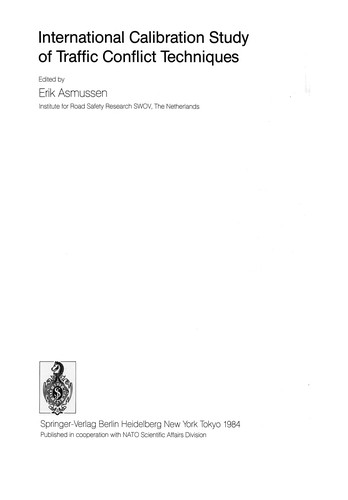
International Calibration Study of Traffic Conflict Techniques (NATO ASI Series / Computer and Systems Sciences)
0
0
As an Amazon Associate and affiliate partner, Menrva Books earns from qualifying purchases. Learn more
Author Description
The concept of traffic conflict was initiated in the Uni ted States in the 60s and raised a lot of interest in many countries: it was an opening towards the develop- ment of a new tool for safety evaluation and the diagnosis of local safety pro- blems. The need for such a tool was great, because of the many situations where accident data was either scarce, unsatisfactory or unavailable. Development of Traffic Conflict Techniques (TCT) started simultaneously in the 70s in several European count ries and new studies were also undertaken in the Uni ted States, Canada and Israel. The need for international cooperation was rapidly feIt, in order to exchange data, compare definitions and check progresses. An Association for International Cooperation on Traffic Conflict Techniques (ICTCT) was therefore created, grouping researchers and safety administrators, with the aim of promoting and organising exchange of information and common practical work. Three Traffic Conflict Techniques Workshops were organised, in Oslo (1977), Paris (1979) and Leidschendam (1982). A small scale international experiment of calibra- tion of TCTs was also carried out in Rouen, France, in 1979, and five teams took part in it from France, Germany, Sweden, the United Kingdom and the United States; results of this first experiment were used as a basis for the present enterprise. To be acknowledged as a safety measuring tool, traffic conflict techniques had to be validated in relation to traditional safety indicators such as injury-accidents.
Menrva's Summary
THE THESIS
This book addresses the critical need for standardized methods in evaluating traffic safety through the calibration of Traffic Conflict Techniques (TCTs). The development of TCTs in the 1960s and 70s offered a promising alternative to scarce accident data for diagnosing local safety issues. However, the simultaneous emergence of these techniques in multiple countries highlighted the necessity for international cooperation to compare definitions, exchange data, and validate methodologies. This study represents a significant effort to achieve that goal, building upon previous workshops and experiments to establish a reliable safety measuring tool.
THE SCOPE MAP
- A detailed account of the International Calibration Study of Traffic Conflict Techniques.
- Discussion on the historical development and interest in Traffic Conflict Techniques (TCTs) since the 1960s.
- Examination of the need for TCTs due to limitations in traditional accident data.
- Overview of the simultaneous development of TCTs in Europe, the United States, Canada, and Israel.
- Information on the Association for International Cooperation on Traffic Conflict Techniques (ICTCT) and its role.
- Reports from previous Traffic Conflict Techniques Workshops and experiments.
- The process and results of calibrating TCTs in relation to traditional safety indicators like injury-accidents.
THE AUTHORITY PERSPECTIVE
This publication serves as a foundational document for researchers and safety administrators involved in traffic safety analysis. It details a crucial international effort to standardize and validate Traffic Conflict Techniques, addressing the limitations of accident data. The work is presented as a collaborative endeavor, stemming from the need for common practical work and data exchange among international researchers. The study's focus on calibration against injury-accidents underscores its commitment to establishing TCTs as a recognized safety measuring tool.
Page Count:
228
Publication Date:
1984-01-01
Publisher:
Springer
ISBN-10:
354012716X
ISBN-13:
9783540127161
Science
Non-Fiction
Transportation Safety
Traffic engineering
Road Safety
Community Tags
Similar Books