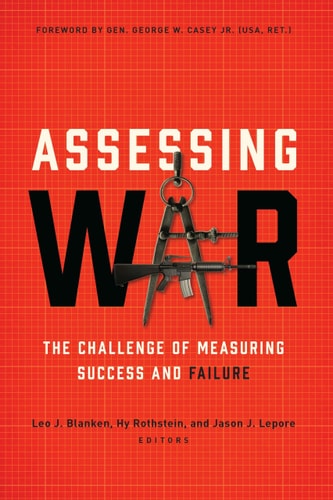
Assessing War: The Challenge of Measuring Success and Failure
0
0
As an Amazon Associate and affiliate partner, Menrva Books earns from qualifying purchases. Learn more
Author Description
Today's protracted asymmetrical conflicts confuse efforts to measure progress, often inviting politics and wishful thinking to replace objective evaluation. In Assessing War, military historians, social scientists, and military officers explore how observers have analyzed the trajectory of war in American conflicts from the Seven Years' War through the war in Afghanistan. Drawing on decades of acquired expertise, the contributors examine wartime assessment in both theory and practice and, through alternative dimensions of assessment such as justice and proportionality, the war of ideas and economics. This group of distinguished authors grapples with both conventional and irregular wars and emerging aspects of conflict--such as cyberwar and nation building--that add to the complexities of the modern threat environment. The volume ends with recommendations for practitioners on best approaches while offering sobering conclusions about the challenges of assessing war without politicization or self-delusion. Covering conflicts from the eighteenth century to today, Assessing War blends focused advice and a uniquely broad set of case studies to ponder vital questions about warfare's past--and its future. The book includes a foreword by Gen. George W. Casey Jr. (USA, Ret.), former chief of staff of the US Army and former commander, Multi-National Force-Iraq.
Menrva's Summary
THE THESIS
This book investigates the persistent challenge of objectively evaluating the success or failure of military conflicts, particularly in the context of modern asymmetrical warfare. The authors, a mix of military historians, social scientists, and officers, explore historical and theoretical frameworks for assessing war, drawing on case studies from the Seven Years' War to the war in Afghanistan. They examine alternative dimensions of assessment, including justice, proportionality, the war of ideas, and economics, while also considering emerging conflict types like cyberwar and nation-building. The volume concludes with practical recommendations for practitioners, offering a sober reflection on the difficulties of unbiased war assessment.
THE SCOPE MAP
- Analysis of wartime assessment in American conflicts from the eighteenth century to the war in Afghanistan.
- Exploration of assessment in both theory and practice.
- Examination of alternative dimensions of assessment: justice, proportionality, the war of ideas, and economics.
- Consideration of conventional, irregular, cyber, and nation-building aspects of conflict.
- Case studies spanning multiple centuries and types of warfare.
- Recommendations for practitioners on best approaches to assessing war.
- Foreword by Gen. George W. Casey Jr. (USA, Ret.)
THE AUTHORITY PERSPECTIVE
The book is presented as a comprehensive exploration of war assessment, drawing on the expertise of distinguished authors from military history, social science, and military practice. It aims to provide both theoretical insights and practical guidance for evaluating conflicts, particularly in the face of modern complexities. The inclusion of a foreword by a former US Army Chief of Staff suggests a focus on actionable intelligence for military professionals. The broad historical scope and consideration of contemporary threats indicate an effort to offer a robust and relevant analysis for understanding warfare's trajectory.
Page Count:
352
Publication Date:
2015-01-01
Publisher:
Georgetown University Press
ISBN-10:
162616245X
ISBN-13:
9781626162457
History
Non-Fiction
Military History
International relations
Community Tags
Similar Books