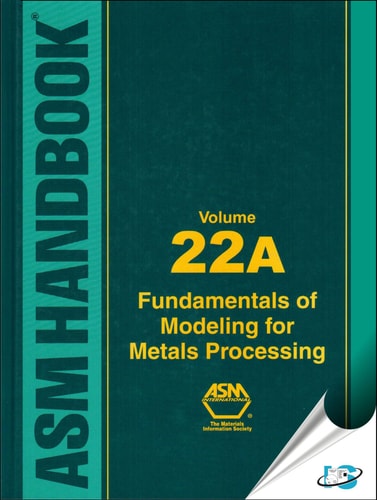
ASM Handbook Volume 22A: Fundamentals of Modeling for Metals Processing
0
0
As an Amazon Associate and affiliate partner, Menrva Books earns from qualifying purchases. Learn more
Author Description
This Handbook provides an overview of the development of models of metallic materials and how the materials are affected by processing. This knowledge is central to understanding of the behavior of existing alloys and the development of new materials that affect nearly every manufacturing industry. Background on fundamental modeling methods provides the user with a solid foundation of the underlying physics that support the mechanistic method of many industrial simulation software packages. The phenomenological method is given equal coverage. The substantial efforts of the past 25 years to develop and implement computer-based models to simulate manufacturing processes, the evolution of microstructures, and the effects on the mechanical properties within component materials are detailed. The rate of change within this area of engineering has continued to increase with increasing industrial benefits from the use of such engineering tools, and the reduced cost and increased speed of computing systems required to perform the extensive model calculations. This book serves as a reference to these developments and the governing principles on which they are based. Leading experts from ten countries have contributed to this effort to provide a comprehensive reference for the modeling practitioner as well as those needing to learn modeling methods. This Volume will be joined by a companion, Volume 22B, Metals Process Simulation, that will provide details on integrating these models into software tools to allow simulation of manufacturing processes.
Menrva's Summary
THE THESIS
This Handbook investigates the fundamental principles and methodologies behind modeling metallic materials and their processing. It details the evolution of computer-based models used to simulate manufacturing processes, microstructural changes, and their impact on mechanical properties. The book provides a comprehensive reference for both experienced modeling practitioners and those seeking to learn these techniques, covering both mechanistic and phenomenological modeling approaches.
THE SCOPE MAP
- Fundamentals of modeling methods in metallic materials processing
- Background on the underlying physics supporting industrial simulation software
- Detailed coverage of phenomenological modeling methods
- Evolution of microstructures and effects on mechanical properties within component materials
- Development and implementation of computer-based models over the past 25 years
- Increasing industrial benefits from engineering tools and computing advancements
- Contributions from leading experts across ten countries
- Reference to developments and governing principles in metals processing modeling
THE AUTHORITY PERSPECTIVE
This volume serves as a comprehensive reference for the modeling practitioner and those new to modeling methods in metals processing. It details the substantial efforts over the past 25 years to develop and implement computer-based models. The book is recognized for its coverage of both fundamental modeling methods and their industrial applications. Its companion volume, Volume 22B, Metals Process Simulation, will further detail the integration of these models into software tools.
Page Count:
775
Publication Date:
2009-12-31
Publisher:
American Society For Metals
ISBN-10:
1615030018
ISBN-13:
9781615030019
Science & Technology
Non-Fiction
Metallurgy
Engineering
Manufacturing processes
Community Tags
Similar Books