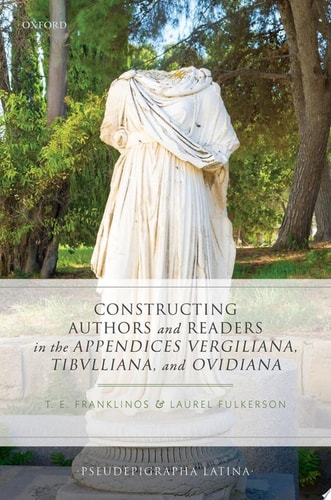
Constructing Authors and Readers in the Appendices Vergiliana, Tibulliana, and Ouidiana
0
0
As an Amazon Associate and affiliate partner, Menrva Books earns from qualifying purchases. Learn more
Author Description
Cover -- Constructing Authorsand Readers In Theappendices Vergiliana,tibulliana, And Ouidiana -- Copyright -- Preface -- Contents -- List Of Contributors -- Authoring, Reading, And Exploring An Appendix: Some Introductory Thoughts -- Why This Volume And Why Now? -- What's In A Name? Appendices Vs Opuscula -- The Three Appendices: What We Think We Know -- Same And Different-variations Among The Appendices -- Summary Of Chapters -- 1 Scylla's Lament In The Ciris And The Latin Literary Tradition -- Scylla's Lament -- Concluding Thoughts -- 2 The Mythical Antecedents Of The Ciris* 3 Author And Audience In Catalepton -- Reading Catalepton: Parameters And Perspectives -- The Design Of The Collection -- Thematic Emphases -- Poems 1 And 7: Tucca, Varius, And The Editor Of Catalepton -- Poems 2, 5, And 8: Rhetoric And Philosophy -- Poems 3 And 9: Great Men -- Poems 4 And 11: Poetry And History -- Poems 5 And 10: Sabinus Ille? -- Poems 6 And 12: Noctuinus And Atilius, Gener Socerque -- 4 Construing The Author As A Catullan Reader In The Pure Iambic Catalepton (6, 10, 12) -- 5 Catalepton 9 And Valgius Rufus 6 Echoing Virgil And Narcissus: Structure And Interpretation Of The Culex* -- Standard' Tripartite Structural Model For The Culex -- Unipartite Structural Model: Ovid's Narcissus Episode As Hypotext -- Ring Composition And Reflection On The Poet And Virgil -- Philosophy And Vision: Lucretius -- Conclusion: The Author Of The Culex -- 7 Volcanic Wonder: A Starry-eyed View Of The Aetna* -- 8 Teaching The Death Of Elegy: The Elegies Of Lygdamus ([tib.] 3.1-6) -- Love Elegy And Cultus -- Love And Death -- Teacher Of Love -- Conclusion 9 Tibullan Impersonation And Callimachean Influence In The Messalla Panegyric ([tib.] 3.7) -- 10 The Authorship Of Tibullus 3.9: Methods And Criteria -- 11 The Authorship Of Sulpicia* -- 12 The Halieutica Attributed To Ovid: Issues Of Authenticity, Reception, And Supplementation* -- The Evidence From Pliny, Natural History -- Halieutica 1-18: Impro
Menrva's Summary
THE THESIS
This volume investigates the complex mechanisms of authorship and reader reception within the minor collections traditionally attributed to Virgil, Tibullus, and Ovid. The editors, Laurel Fulkerson and Tristan E. Franklinos, compile a series of scholarly essays that examine how these texts—often marginalized as appendices—actively construct their own authorial identities and engage with their intended audiences. By applying modern philological and literary methodologies, the contributors challenge traditional assumptions regarding authenticity and the historical context of these works.
THE SCOPE MAP
What You Will Find
- Analysis of the Appendix Vergiliana, including the Ciris, Catalepton, Culex, and Aetna.
- Examination of the Tibullian corpus, specifically the elegies of Lygdamus and the Messalla Panegyric.
- Discussion of the Halieutica attributed to Ovid.
- Methodologies for assessing authorship, intertextuality, and the influence of Callimachean poetics.
Scope Limits
- The volume does not provide a comprehensive commentary on every line of the included poems.
- It does not attempt to definitively resolve all historical debates regarding the true identity of the authors.
THE AUTHORITY PERSPECTIVE
Scholars in the field of classical studies recognize this collection as a significant contribution to the study of pseudepigrapha and the reception of Roman poetry. Readers frequently note the academic density of the prose, which is intended primarily for specialists and advanced students of Latin literature.
Page Count:
320
Publication Date:
2020-01-01
Publisher:
Oxford University Press,
ISBN-10:
0192633406
ISBN-13:
9780192633408
Poetry
Virgil
Classical Philology
Latin poetry
Criticism and interpretationTibullus
Academic
Literary Criticism
Tibullus
Latin
Community Tags
Similar Books

Reader Comments
Share Your Thoughts
No comments yet. Be the first to share your thoughts!