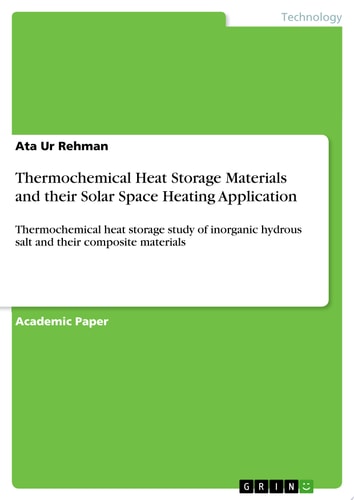
Thermochemical Heat Storage Materials and their Solar Space Heating Application: Thermochemical heat storage study of inorganic hydrous salt and their composite materials
0
0
As an Amazon Associate and affiliate partner, Menrva Books earns from qualifying purchases. Learn more
Author Description
Thermochemical heat storage materials offer high-energy storage densities and clean means of long-term solar energy storage. The aim of the study is to assess the potential heat storage efficiency of salt hydrates, based on sufficient hydration/dehydration performance, water sorption and cyclicability. MgSO4•7H2O, ZnSO4•7H2O and FeSO4•7H2O were evaluate based on preselected criteria. The main highlights of the dehydration result show that higher enthalpy was obtained for MgSO4 and ZnSO4, shows 2256 J g-1 and 1731 J g-1 enthalpy, respectively. During hydration process, six water molecules were absorbing by MgSO4 and ZnSO4 after pre-dehydrated temperature 150 °C and 120 °C, respectively. The cycle stability of MgSO4 and ZnSO4 showed better performance which give rise 1210 g-1 and 1155 J g-1 enthalpy, respectively. It was expected that FeSO4 would show higher cyclicability due to their higher enthalpy (1400 J g-1) in the first round; however, overhydration does not permit it to released larger energy. The impact of relative humidity on water sorption performance and rate of hydration were reported which showed that MgSO4 and ZnSO4 can uptake maximum water under 85 and 75 % relative humidity. Ongoing studies and the booming progress of ZnSO4•7H2O illustrate that likewise MgSO4•7H2O, it is also the potential candidate and can be use in thermochemical heat storage devices. To bring zinc sulfate heptahydrate into market, more detail studies in fields of evaluation of advanced materials and development of efficient and compact prototypes are still required. ZnSO4·7H2O is modified by impregnation method with zeolite matrices (13X-zeolite and LTA-zeolite) to improve its hydration performance. Water sorption ability of composites was carried out in a constant temperature &
Menrva's Summary
THE THESIS
This study investigates the potential of thermochemical heat storage materials, specifically inorganic hydrous salts and their composites, for solar space heating applications. The research assesses the heat storage efficiency of salt hydrates like MgSO4•7H2O, ZnSO4•7H2O, and FeSO4•7H2O based on their hydration/dehydration performance, water sorption capabilities, and cyclic stability. The findings highlight MgSO4 and ZnSO4 as promising candidates due to their high enthalpy values and water absorption capacities under specific relative humidity conditions. Further development and prototype testing are suggested to bring these materials to market.
THE SCOPE MAP
- Evaluation of MgSO4•7H2O, ZnSO4•7H2O, and FeSO4•7H2O for thermochemical heat storage.
- Measurement of dehydration enthalpy, showing high values for MgSO4 (2256 J g-1) and ZnSO4 (1731 J g-1).
- Analysis of water sorption during hydration, with MgSO4 and ZnSO4 absorbing six water molecules.
- Assessment of cycle stability, with MgSO4 and ZnSO4 retaining significant enthalpy after multiple cycles.
- Investigation into the impact of relative humidity on water sorption performance.
- Modification of ZnSO4•7H2O with zeolite matrices (13X and LTA) to enhance hydration performance.
- Discussion on the potential of ZnSO4•7H2O as a viable candidate for thermochemical heat storage devices.
THE AUTHORITY PERSPECTIVE
This academic paper presents a detailed experimental evaluation of inorganic hydrous salts for thermochemical heat storage, focusing on their application in solar space heating. The research provides quantitative data on dehydration enthalpy, water sorption, and cyclic stability for key salt hydrates, identifying MgSO4 and ZnSO4 as particularly promising materials. The study also explores composite materials, specifically ZnSO4 modified with zeolite matrices, to improve performance. The work concludes by emphasizing the need for further research and prototype development to commercialize these energy storage solutions.
Page Count:
58
Publication Date:
2020-05-19
Publisher:
GRIN Verlag
ISBN-10:
334616988X
ISBN-13:
9783346169884
Science
Non-Fiction
Chemical Engineering
Solar energy
Energy storage
Community Tags
Other Editions(2)
Similar Books








Reader Comments
Share Your Thoughts
No comments yet. Be the first to share your thoughts!