Insights of Current Developments in Optics-Based-Biosensors for Analysis of Environmental Contamination and Pollution
0
0
As an Amazon Associate and affiliate partner, Menrva Books earns from qualifying purchases. Learn more
Author Description
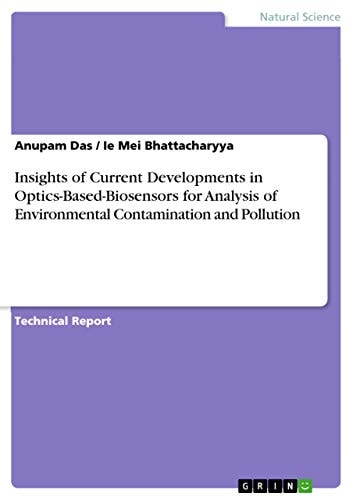
As the process of industrialisation evolves, more and more pollutants add to the environment and put the health of the living world at stake. So the necessity to design user-friendly, advanced systems to detect and control these contaminants with high accuracy, sensitivity and stability has gained prime importance. Several conventional instruments are still in use but they have many drawbacks. Optical biosensors can be a suitable alternative to overcome the limitations of the conventional techniques as they are capable of real-time, high frequency monitoring of the pollutants with high accuracy, sensitivity, selectivity and precision. This article discusses about the various types of bio receptors which react to the analytes and how different techniques can be employed for their accurate detection by analysing the interaction of the bio receptors with the contaminants. This article also puts to light the remarkable developments in the field of optical biosensors and bio-recognition elements and their applications in pollution control.
Menrva's Summary
THE THESIS
The increasing prevalence of industrialization necessitates advanced systems for detecting and controlling environmental pollutants. The authors address the limitations of conventional instruments by exploring optical biosensors as a superior alternative, capable of real-time, high-frequency monitoring with exceptional accuracy, sensitivity, selectivity, and precision. This technical report details the various bioreceptor types that interact with analytes and discusses detection methodologies based on the interaction of bioreceptors with contaminants.
THE SCOPE MAP
- Discussion of various bioreceptor types and their reaction to specific analytes.
- Analysis of different optical detection techniques for accurate contaminant identification.
- Examination of the interaction between bioreceptors and environmental contaminants.
- Highlights of recent advancements in optical biosensor technology and bio-recognition elements.
- Applications of optical biosensors in pollution control and environmental monitoring.
THE AUTHORITY PERSPECTIVE
This technical report, originating from a 2015 M.TECH course, focuses on the technical aspects of optical biosensors for environmental analysis. The material presented is likely to appeal to specialists in physics, optics, and environmental science, offering a detailed look at detection methodologies and technological advancements. The emphasis on accuracy, sensitivity, and real-time monitoring suggests a practical, application-oriented approach to tackling pollution challenges. The report aims to provide a comprehensive overview of the field's progress and its utility in environmental protection.
Page Count:
32
Publication Date:
2015-05-07
Publisher:
GRIN Verlag
ISBN-10:
3656956995
ISBN-13:
9783656956990
Science
Non-Fiction
Pollution Control
Analytical Chemistry
Optics
Biosensors