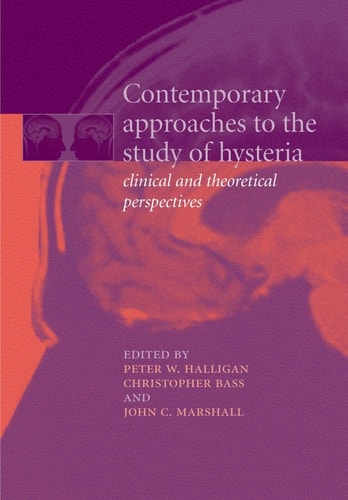
Contemporary Approaches to the Study of Hysteria: Clinical and Theoretical Perspectives
0
0
As an Amazon Associate and affiliate partner, Menrva Books earns from qualifying purchases. Learn more
Author Description
Patients with striking physical symptoms suggestive of a neurological disease, but no evidence of nervous system damage are typically labelled as suffering from "hysterical conversion". Despite claims that conversion disorders have disappeared from clinical practice, patients with conversion symptoms continue to present diagnostic conundrums to clinicians. The disorder accounts for 4% of all referrals to neurology services. This book covers aspects neglected by previous works on this controversial condition, moving away from traditional historico-sociological accounts towards neuroscientific theories about the causes and categorization of hysteria. Recent investigations using functional imaging and hypnosis are covered, as are the neuropsychological accounts inspired by them, alongside more traditional psychodynamic accounts. A section on medico-legal aspects is innovative and timely. The key causal role of life events is also addressed, along with the influence of military conflict and culture in shaping and modifying clinical presentations, and changes in physical manifestations of hysteria through the centuries. Contemporary Approaches to the Science of Hysteria, with contributions from a distinguished international team, representative of all interested specialty groups, aims to demonstrate that hysterical conversion remains clinically important, with potential for empirical research in both social and medical sciences, as well as offering a fertile source for advancing neuroscience.
Menrva's Summary
THE THESIS
This volume investigates the persistent diagnostic challenges and evolving theoretical frameworks surrounding hysterical conversion disorders in modern clinical practice. The authors, a team of distinguished international experts, synthesize historical perspectives with contemporary neuroscientific data to argue that hysteria remains a significant, empirically researchable condition. By integrating functional imaging, neuropsychological models, and psychodynamic theory, the text provides a comprehensive framework for understanding the etiology and manifestation of these complex symptoms.
THE SCOPE MAP
What You Will Find
- Neuroscientific theories regarding the causes and categorization of conversion disorders
- Analysis of functional imaging and hypnosis in clinical investigation
- Medico-legal implications of conversion symptom diagnosis
- Examination of the influence of culture, military conflict, and life events on clinical presentation
Scope Limits
- Does not provide a singular, unified diagnostic manual for practitioners
- Excludes extensive focus on traditional historico-sociological accounts in favor of empirical science
THE AUTHORITY PERSPECTIVE
Experts recognize this text as a vital resource for bridging the gap between traditional psychodynamic views and modern neuroscientific inquiry. Readers frequently note the academic density of the prose, which serves as a foundational reference for clinicians and researchers navigating the complexities of conversion disorders.
Page Count:
368
Publication Date:
2001-06-07
Publisher:
Oxford University Press
ISBN-10:
019263254X
ISBN-13:
9780192632548
Psychology
Neurology
Hysteria
Psychiatry
Neuroscience
Community Tags
Similar Books