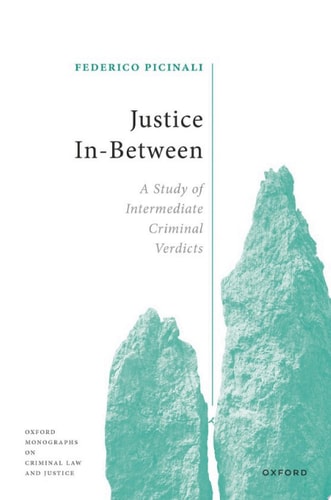
Justice In-Between: A Study of Intermediate Criminal Verdicts
0
0
As an Amazon Associate and affiliate partner, Menrva Books earns from qualifying purchases. Learn more
Author Description
Most contemporary criminal justice systems adopt a 'binary' system of verdicts. In a binary system, there is a single evidential threshold, or standard of proof. If the standard is met, the verdict is 'guilty', the defendant is convicted, and punishment is permitted. If the standard is not met, the verdict is 'not guilty', the defendant is acquitted, and punishment is forbidden. There is no middle ground between the verdict of 'not guilty' and that of 'guilty'. An intermediate verdict represents such middle ground, intermediate between acquittal and conviction both in terms of the strength of the incriminating evidence that is needed to warrant the verdict and in terms of the severity of the consequences that the verdict may produce for the defendant. Justice In-Between is a study of intermediate criminal verdicts and advances a novel justification of such controversial devices, with the aim to produce a consensus amongst scholars subscribing to different theories of punishment. Indeed, the book shows that one cannot investigate the choice of the standard of proof nor, importantly, that of the verdict system, in isolation from the question of the justification for punishing. Justice In-Between studies historical and extant examples of intermediate criminal verdicts and engages with the debates that have accompanied them, including the popular argument that intermediate criminal verdicts are incompatible with the presumption of innocence. In doing so, the book offers an original account of the meaning and of the justification of the presumption. Relying on decision theory, Justice In-Between makes a case for intermediate criminal verdicts and shows that such decision-theoretic case is viable under any of the main theories of punishment.
Menrva's Summary
THE THESIS
This book investigates the theoretical and practical viability of intermediate criminal verdicts as an alternative to the traditional binary system of guilty or not guilty. Federico Picinali, a scholar in criminal law, utilizes decision theory and historical analysis to argue that intermediate verdicts can be justified across various theories of punishment. The text challenges the conventional view that such verdicts inherently violate the presumption of innocence by providing a new framework for understanding the meaning and justification of that presumption.
THE SCOPE MAP
What You Will Find
- Analysis of historical and extant examples of intermediate criminal verdicts.
- Application of decision theory to the standard of proof and verdict systems.
- A re-evaluation of the presumption of innocence within criminal law.
- Comparative study of binary versus non-binary verdict systems.
Scope Limits
- The book does not provide a comprehensive survey of every global legal system.
- It does not offer a practical manual for courtroom procedure or trial advocacy.
THE AUTHORITY PERSPECTIVE
Legal scholars and academics recognize this work as a rigorous contribution to the philosophy of criminal law. Readers frequently note the high level of academic density and the sophisticated application of decision-theoretic models to traditional legal problems.
Page Count:
292
Publication Date:
2022-01-01
Publisher:
OUP Oxford
ISBN-10:
0192633546
ISBN-13:
9780192633545
Professional Career & Trade
Great Britain
Criminology
Law
Legal Theory
Law Philosophy
Community Tags
Similar Books