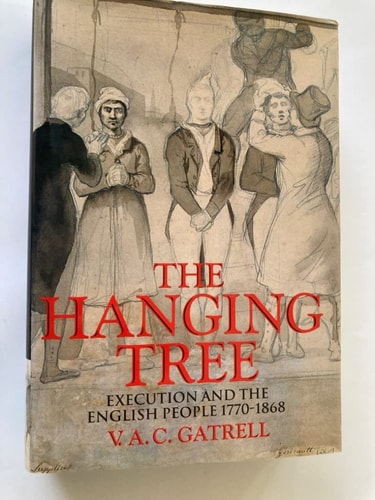
The Hanging Tree: Execution and the English People 1770-1868
0
0
As an Amazon Associate and affiliate partner, Menrva Books earns from qualifying purchases. Learn more
Author Description
Some thirty-five thousand people were condemned to death in England and Wales between 1770 and 1830, and seven thousand were ultimately executed, the majority convicted of crimes such as burglary, horse theft, or forgery. Mostly poor trades people--weavers, clerks, whipmakers--these terrified men and women would suffer excruciating death before large and excited crowds. Indeed, crowds of three to seven thousand were normal, and for famous cases, the mob could swell to fifty thousand or more (a hundred thousand were said to have watched the hanging of murderers Holloway and Haggarty--so great a throng that thirty spectators were crushed to death). What brought people out for such a gruesome spectacle? How did they feel about the deadly justice meted out in their midst? These are some of the questions examined in The Hanging Tree, a fascinating history of public executions in their awful heyday in England.Drawing on letters, diaries, ballads, and poignant appeals for mercy, V.A.C. Gatrell vividly recreates the social atmosphere and heated debate swirling about these cruel spectacles. He gives readers an unflinching look at what these executions were really like, paints a colorful portrait of the large crowds who gathered to watch, and describes the part the gallows played in the popular imagination (as reflected in flash ballads, Punch and Judy shows, and broadsides). Gatrell illuminates the debate over public execution that raged in polite society, discussing the commentary of writers such as Boswell, Byron, Thackeray, and Dickens, most of whom deplored the behavior of the crowd more than the inhumanity of the sentence (Macaulay denounced abolitionists as effeminate). And Gatrell also examines the attitudes of the judges, politicians, and monarch who decided who should be reprieved and who should hang (a mortal decision often delivered with the one-sentence formula: "Let the law run its course"). Throughout the book, Gatrell traces how attitudes to death and suffering changed.
Menrva's Summary
THE THESIS
This work investigates the cultural and social significance of public executions in England between 1770 and 1868, questioning why these spectacles drew massive crowds and how they reflected the shifting moral landscape of the era. V. A. C. Gatrell, a distinguished historian, utilizes an extensive array of primary sources—including personal diaries, legal records, and popular ballads—to reconstruct the experience of the gallows. He argues that the public execution was not merely a tool of state power, but a complex social event that revealed deep-seated tensions between the ruling elite and the common people regarding justice, suffering, and state-sanctioned violence.
THE SCOPE MAP
What You Will Find
- A detailed examination of the legal and social history of capital punishment in England and Wales from 1770 to 1868.
- Analysis of the role of popular media, such as broadsides and Punch and Judy shows, in shaping public perception of the gallows.
- Primary source evidence derived from letters, petitions for mercy, and contemporary literary commentary from figures like Dickens and Thackeray.
- An exploration of the decision-making processes of judges and the monarchy regarding reprieves and the application of the death penalty.
THE AUTHORITY PERSPECTIVE
Historians and legal scholars frequently cite this work as a definitive study on the intersection of penal practice and popular culture in the eighteenth and nineteenth centuries. Readers often note the academic density of the prose, which provides a comprehensive and rigorous analysis of the social dynamics surrounding the English gallows.
Page Count:
656
Publication Date:
1994-12-08
Publisher:
Oxford University Press
ISBN-10:
0198204132
ISBN-13:
9780198204138
History
Social History
Criminology
Hanging
British History
Legal History
Great Britain
Community Tags
Similar Books