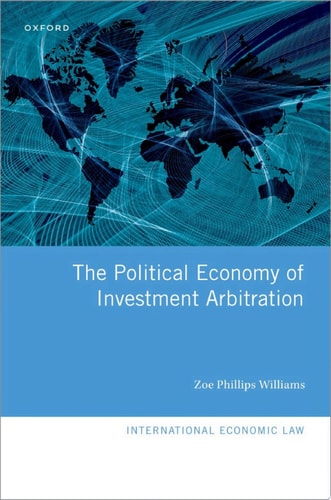
The Political Economy of Investment Arbitration
0
0
As an Amazon Associate and affiliate partner, Menrva Books earns from qualifying purchases. Learn more
Author Description
The Political Economy of Investment Arbitration asks how political institutions and actors in the host state of an investment contribute to the emergence of investor-state disputes. Combining insights from international relations and political economy, it considers two opposing explanations for investor-state disputes: shifting state preferences toward FDI, or the lack of state capacity to maintain an investment-friendly environment. This book's overarching conclusion is that democratic institutions in host states contribute to the emergence of investor-state disputes. Phillips Williams argues that at the heart of many investor-state disputes are highly politicized distributional conflicts involving a range of domestic interest groups. Indeed, it is often pressure from these groups, whether through voting, protests or lobbying, which motivates states to take the policy decisions that are subsequently subject to investors' legal challenges. Thus, this monograph demonstrates that in the face of the potentially high costs posed by investment arbitration, governments continue to take measures which may harm investors in order to pursue specific policy goals. More importantly, these disputes are not only the result of corruption or weak rule of law, but of measures which are taken at the behest of broader interest groups and relate to clear public policy concerns. This has important implications of our normative assessment of the regime and is highly relevant to current debates in both international law and international political economy about the relationship between investment treaties and domestic politics.
Menrva's Summary
THE THESIS
This book investigates how domestic political institutions and interest groups within host states influence the emergence of investor-state disputes. Zoe Phillips Williams, a scholar in international law and political economy, utilizes a framework that synthesizes international relations theory with political economy to challenge the conventional view that disputes arise solely from corruption or weak rule of law. She argues that democratic institutions and pressure from domestic interest groups often drive states to enact policies that trigger legal challenges from foreign investors.
THE SCOPE MAP
What You Will Find
- Analysis of the relationship between democratic institutions and investment arbitration.
- Theoretical framework combining international relations and political economy.
- Examination of how domestic interest groups, lobbying, and public protests influence state policy.
Scope Limits
- The text does not provide a comprehensive legal manual for practitioners of arbitration.
- It does not focus on the technical procedural aspects of arbitration tribunals.
THE AUTHORITY PERSPECTIVE
Experts in international economic law highlight this text as a significant contribution to the understanding of the political drivers behind investment disputes. Readers frequently note the academic density of the prose, which is well-suited for researchers and practitioners interested in the intersection of law and domestic politics.
Page Count:
336
Publication Date:
2022-01-01
Publisher:
OUP Oxford
ISBN-10:
019263545X
ISBN-13:
9780192635457
Economics
International relations
Professional Career & Trade
Law
International Law
Community Tags
Similar Books