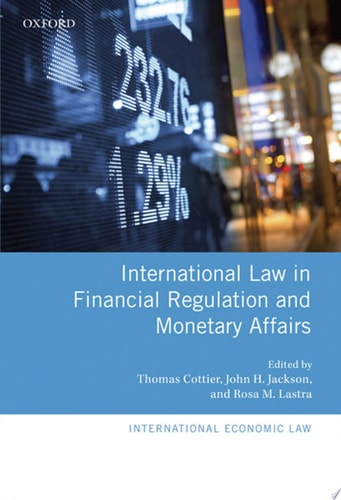
International Law in Financial Regulation and Monetary Affairs
0
0
As an Amazon Associate and affiliate partner, Menrva Books earns from qualifying purchases. Learn more
Author Description
The Early Twenty-first Century Has Seen A Conspicuous Absence Of Formal International Law Concerning Money And Finance. This Book Argues That This Lack Of Formal International Regulation Was A Significant Contributing Factor To The Global Financial Crisis That Began In 2007. It Focuses On This Lack Of Global Substantive Principles And 'hard Law' Rules In The Field Of Financial Regulation And Monetary Affairs, And Analyses The Emerging Framework Within International Law That Aims To Govern Financial Institutions And Markets. The Global Financial Crisis Has Demonstrated The Essential Need For Financial And Monetary Regulatory Reform, And For The Establishment Of Appropriate Mechanisms For The Settlement Of Financial Disputes And For The Regulation Of Cross-border Financial Institutions. This Book Therefore Presents The Foundations Of Solutions That Could Fill These Critical Gaps In International Financial Law. It Addresses Cross-border Issues, Financial Regulation, And Provides Detailed Analyses Of Monetary Policies And Regulation. This Book Is An Updated Collection Of Papers First Published In The Special Edition Of The Journal Of International Economic Law On 'the Quest For International Law In Financial Regulation And Monetary Affairs' (volume 12, Number 3, September 2010), Which Also Show That The Regulatory Hands-off Approach Was Not Replicated In Other Areas Of International Economic Law. International Trade Regulation Witnessed An Increased Number Of International Rules And The Reinforcement Of A Rule-oriented, If Not Rule-based, Approach. Judicial Dispute Settlement And Retaliation, Exclusively Based Upon International Ruling And Authorization, Was Reinforced. Given The Importance Of Trade Regulation And Wto Law, Which Has An Established Institutional And Legal Framework, The Book Therefore Provides A Much-needed Comparative Approach.
Menrva's Summary
THE THESIS
This work investigates the absence of formal international law in the realms of money and finance and argues that this regulatory void served as a primary catalyst for the 2007 global financial crisis. The authors, including prominent scholars in international economic law, utilize a comparative framework to contrast the lack of substantive 'hard law' in financial markets with the highly structured, rule-oriented environment of international trade regulation. They propose foundational mechanisms for dispute settlement and cross-border institutional oversight to address these systemic vulnerabilities.
THE SCOPE MAP
What You Will Find
- Comparative analysis between international trade law and financial regulatory frameworks
- Examination of the 'hands-off' approach to global monetary policy
- Proposals for institutional mechanisms to govern cross-border financial institutions
- Theoretical foundations for establishing substantive international financial principles
Scope Limits
- Does not provide a comprehensive history of the 2007 crisis itself
- Does not offer a step-by-step guide for individual national regulatory implementation
THE AUTHORITY PERSPECTIVE
Experts identify this collection as a critical academic resource for understanding the legal gaps that preceded the global financial crisis. Readers frequently note the high level of technical density and the rigorous comparative methodology employed by the contributors.
Page Count:
470
Publication Date:
2012-01-01
Publisher:
Oxford University Press
ISBN-10:
0191645206
ISBN-13:
9780191645204
Economics
Finance
International Law
Law
Community Tags
Other Editions(3)
Similar Books





Reader Comments
Share Your Thoughts
No comments yet. Be the first to share your thoughts!