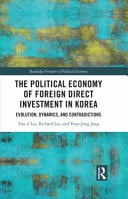
The Political Economy of Foreign Direct Investment in Korea
0
0
As an Amazon Associate and affiliate partner, Menrva Books earns from qualifying purchases. Learn more
Author Description
One of the most spectacular phenomena in the South Korean political economy has been the remarkable escalation of international capital investment, particularly inward foreign direct investment (FDI). This book provides an in-depth look at the evolution of FDI in Korea, from the late 1990s to the present day. Charting Korea’s transition from state-led capitalism to a more liberalized market, this book assesses the complex interplay between government policy, foreign capital inflows, and multinational corporations (MNCs). It analyzes the key economic policies of the past as well as more recent measures by the Moon Jae-in and Yoon Suk Yeol administrations. The book then conducts an analysis of the socio-economic, cultural, and political dynamics that shape strategies of MNCs today. The book draws on 36 interviews with CEOs of foreign companies operating in Korea to seek their insights into the realities of doing business in Korea. It closes by highlighting the current challenges Korea faces today in integrating into the international economy and suggests solutions for sustaining its economic growth. This book will appeal to scholars of political economy, Korean studies, and economic development. It will also interest business leaders and policymakers seeking a deeper understanding of insights into Korea’s economic climate.
Menrva's Summary
THE THESIS
This book investigates the significant rise of foreign direct investment (FDI) in South Korea and its complex relationship with the nation's evolving political economy. It traces the trajectory of FDI from the late 1990s through recent administrations, examining the shift from state-led capitalism to a more liberalized market. The analysis explores the intricate connections between government policies, the influx of foreign capital, and the strategies of multinational corporations. By incorporating insights from 36 interviews with CEOs of foreign companies operating in Korea, the book offers a nuanced perspective on the challenges and opportunities within the Korean economic landscape.
THE SCOPE MAP
- Analysis of FDI evolution in Korea from the late 1990s to the present.
- Examination of Korea's transition from state-led capitalism to a liberalized market.
- Assessment of the interplay between government policy, foreign capital, and multinational corporations.
- Review of economic policies from past administrations and the Moon Jae-in and Yoon Suk Yeol administrations.
- Analysis of socio-economic, cultural, and political dynamics influencing MNC strategies.
- Insights from 36 interviews with CEOs of foreign companies in Korea.
- Discussion of current challenges in integrating into the international economy and suggestions for sustained economic growth.
THE AUTHORITY PERSPECTIVE
The book is positioned as a key resource for scholars of political economy, Korean studies, and economic development, offering an in-depth look at a significant phenomenon in South Korea's economic history. It is also intended to provide valuable insights for business leaders and policymakers interested in Korea's economic climate and its integration into the global economy. The inclusion of interviews with CEOs suggests a practical and empirically grounded approach to understanding the realities of foreign investment in the country. The analysis of recent policy shifts indicates a contemporary relevance for understanding Korea's ongoing economic trajectory.
Page Count:
174
Publication Date:
2025-08-15
Publisher:
Taylor & Francis
ISBN-10:
1040412092
ISBN-13:
9781040412091
Non-Fiction
Politics
Economics
Korean Studies
International business
Government Policy
Community Tags
Similar Books