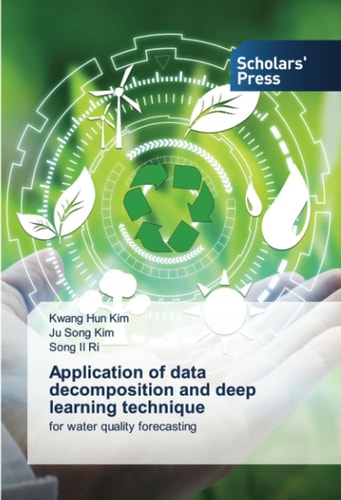
Application of Data Decomposition and Deep Learning Technique
0
0
As an Amazon Associate and affiliate partner, Menrva Books earns from qualifying purchases. Learn more
Author Description
Water pollution is one of the most serious environmental problems worldwide. Accurate forecast of water quality is of great importance since it can provide useful information for the managers to minimize the impact of water pollution. However, water quality forecasting still remains a challenge due to the limited information about the pollution resources and the high uncertainties of the dynamic processes. Most of the existing water quality forecast models are based on the original data without preprocessing. Water quality data is usually of high complexity and non-stationary, and therefore, forecasting models without any data preprocessing could not provide stable prediction result, particularly, for the time points with rapid change.In this regard, this book proposes some novel hybrid models based on data decomposition and deep learning neural network. We describes a new chlorophyll-a forecast method that combines empirical wavelet transform, support vector regression, and sine cosine algorithm, a novel hybrid model combining real-time data decomposition, fuzzy C-means clustering (FCM) and bidirectional gated recurrent unit and a novel hybrid model.
Menrva's Summary
THE THESIS
This book addresses the critical challenge of accurately forecasting water quality amidst global pollution concerns and inherent system uncertainties. The authors propose novel hybrid models integrating data decomposition techniques with deep learning neural networks to overcome the limitations of traditional forecasting methods. By employing strategies such as empirical wavelet transform, support vector regression, sine cosine algorithm, fuzzy C-means clustering, and bidirectional gated recurrent units, the book aims to provide more stable and reliable predictions, particularly for dynamic water quality changes.
THE SCOPE MAP
- Novel hybrid models combining data decomposition and deep learning for water quality forecasting.
- A chlorophyll-a forecast method integrating empirical wavelet transform, support vector regression, and sine cosine algorithm.
- A hybrid model incorporating real-time data decomposition, fuzzy C-means clustering (FCM), and bidirectional gated recurrent units.
- Discussion of challenges in water quality forecasting due to limited pollution resource information and dynamic process uncertainties.
- Analysis of high complexity and non-stationary characteristics of water quality data.
- Methods to achieve stable prediction results, especially at time points with rapid changes.
THE AUTHORITY PERSPECTIVE
The proposed hybrid models, combining data decomposition and deep learning, offer a sophisticated approach to the persistent challenge of water quality forecasting. The methodology described aims to enhance prediction stability by addressing the inherent complexity and non-stationarity of water quality data. By integrating techniques like empirical wavelet transform, support vector regression, fuzzy C-means clustering, and gated recurrent units, the book presents advanced solutions for environmental management.
Page Count:
148
Publication Date:
2025-04-15
Publisher:
KS Omniscriptum Publishing
ISBN-10:
3659839647
ISBN-13:
9783659839641
Non-Fiction
Science
Data Science
Forecasting
Water Quality
Machine Learning
Community Tags
Similar Books