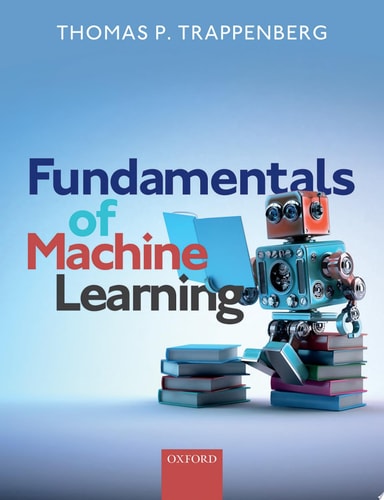
Fundamentals of Machine Learning
0
0
As an Amazon Associate and affiliate partner, Menrva Books earns from qualifying purchases. Learn more
Author Description
Interest in machine learning is exploding worldwide, both in research and for industrial applications. Machine learning is fast becoming a fundamental part of everyday life. This book is a brief introduction to this area - exploring its importance in a range of many disciplines, from science to engineering, and even its broader impact on our society. The book is written in a style that strikes a balance between brevity of explanation, rigorous mathematical argument, and outlines principle ideas. At the same time, it provides a comprehensive overview of a variety of methods and their application within this field. This includes an introduction to Bayesian approaches to modeling, as well as deep learning. Writing small programs to apply machine learning techniques is made easy by high level programming systems, and this book shows examples in Python with the machine learning libraries 'sklearn' and 'Keras'. The first four chapters concentrate on the practical side of applying machine learning techniques. The following four chapters discuss more fundamental concepts that includes their formulation in a probabilistic context. This is followed by two more chapters on advanced models, that of recurrent neural networks and that of reinforcement learning. The book closes with a brief discussion on the impact of machine learning and AI on our society. Fundamentals of Machine Learning provides a brief and accessible introduction to this rapidly growing field, one that will appeal to students and researchers across computer science and computational neuroscience, as well as the broader cognitive sciences.
Menrva's Summary
THE THESIS
This book investigates the core principles and practical applications of machine learning within a framework that balances mathematical rigor with accessible implementation. Thomas P. Trappenberg, drawing on his background in computational neuroscience and computer science, presents a structured overview of the field. The text integrates theoretical foundations with modern computational tools to explain how machine learning models function across various scientific and engineering disciplines.
THE SCOPE MAP
What You Will Find
- Practical application techniques using Python libraries such as sklearn and Keras
- Foundational concepts formulated within a probabilistic context
- Advanced modeling techniques including recurrent neural networks and reinforcement learning
- Discussions on the societal impact of artificial intelligence
Scope Limits
- The text serves as a brief introduction rather than an exhaustive reference manual
- It does not provide deep-dive theoretical proofs for every algorithm presented
THE AUTHORITY PERSPECTIVE
Readers frequently note that the text successfully bridges the gap between high-level conceptual overview and practical coding implementation. Experts highlight this as a useful introductory resource for students and researchers in cognitive sciences and computer science who require a concise entry point into the field.
Page Count:
259
Publication Date:
2019-01-01
Publisher:
OUP Oxford
ISBN-10:
0192563092
ISBN-13:
9780192563095
Computer Science
Machine Learning
Mathematics
Programming
Professional Career & Trade
Data Science