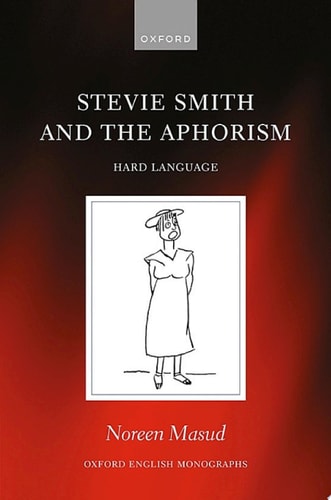
Stevie Smith and the Aphorism: Hard Language
0
0
As an Amazon Associate and affiliate partner, Menrva Books earns from qualifying purchases. Learn more
Author Description
This volume argues that aphorism represents a tool for the social management of emotion. Rhetorically corralled into a slick, collectable shape, the aphorism promises arresting and instantaneous epiphany. However, the accomplished elegance which positions the aphorism's message as self-evidently true in fact works to repel further enquiry, and ultimately ensures that it will be forgotten or bypassed in favour of another aphorism: no less eagerly embraced for the earlier disappointment. Aphorism, therefore, is a form in which dangerous ideas and emotions can be safely displayed and, simultaneously, effaced. Because aphorism's style defuses the imperative to act on what is clearly known, writers like Stevie Smith can use the form to stage a withdrawal from the burden of making an impact on the world. This book finds that Smith's use of aphorism and its related forms (proverb, epitaph, caption, and fragment) offers a route into her texts. With her disconcerting pen-and-ink drawings, dark comedy, and social ventriloquism which stops short of satire, the rhetorical force of Smith's poetry fascinates and arrests its readers, but nevertheless leaves them unable to react coherently or identify the use-value which her writing appears to promise. Drawing on hitherto unpublished archival material, this project argues that Smith's texts resist analysis because, like the aphorisms embedded throughout them, they offer and exemplify a mode of clearly-declared revelation which, at the same time, makes itself unusable.
Menrva's Summary
THE THESIS
This volume investigates how the aphorism functions as a mechanism for the social management of emotion and a tool for rhetorical withdrawal in the work of Stevie Smith. Noreen Masud, an academic specializing in twentieth-century literature, utilizes archival research and close textual analysis to argue that Smith employs aphoristic forms—such as proverbs, epitaphs, and fragments—to present dangerous ideas that simultaneously resist coherent interpretation or practical application. By examining the interplay between Smith's poetry and her visual art, the author demonstrates how the form serves to defuse the reader's impulse to act, effectively staging a retreat from the burden of social impact.
THE SCOPE MAP
What You Will Find
- Analysis of Stevie Smith's poetry, prose, and pen-and-ink illustrations.
- Theoretical framework regarding the rhetorical function of aphorisms in literature.
- Examination of unpublished archival materials related to Smith's creative process.
- Discussion of related forms including proverbs, epitaphs, captions, and fragments.
Scope Limits
- The study focuses primarily on Smith's specific use of aphoristic structures rather than a comprehensive biography.
- The analysis does not attempt to resolve the ambiguity of Smith's work into a singular, unified meaning.
THE AUTHORITY PERSPECTIVE
Scholars and critics recognize this work as a significant contribution to the study of Stevie Smith, particularly for its focus on the intersection of her visual and textual output. Readers frequently note the academic density of the prose, which provides a rigorous framework for understanding the elusive nature of Smith's literary style.
Page Count:
319
Publication Date:
2022-01-01
Publisher:
OUP Oxford
ISBN-10:
0192649248
ISBN-13:
9780192649249
Fairy Tales
English literature
Literary theory
Academic
British literature
Literary Criticism
Community Tags
Similar Books