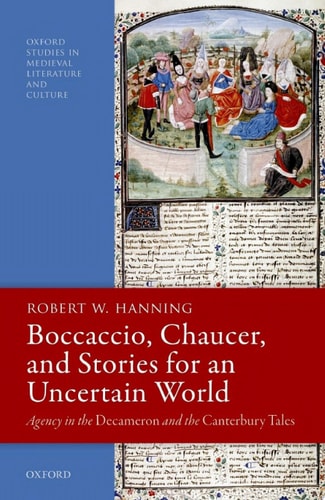
Boccaccio, Chaucer, and Stories for an Uncertain World: Agency in the Decameron and the Canterbury Tales
0
0
As an Amazon Associate and affiliate partner, Menrva Books earns from qualifying purchases. Learn more
Author Description
Boccaccio, Chaucer, and Stories for an Uncertain World understands the Decameron and the Canterbury Tales to communicate a radical uncertainty haunting most human endeavors, one that challenges effective knowledge of the future, the past, or the distant present; accurate perception of both complex, equivocal signifying systems, including language, and the intentions hidden rather than revealed by the words and deeds of others; and successful strategy in dealing with the chronic excesses and arbitrariness of power. This comparative study of Decameron novelle and Canterbury pilgrim tales yields the insight that the key to coping with these challenges is pragmatic prudence: rational calculation issuing in an opportunistic, often amoral choice of ingenious deeds and/or eloquent words appropriate (though without guarantee) to mastering a specific crisis, and achieving the goal of agency in the here and now, not salvation in the Hereafter. An initial chapter explores the Aristotelian antecedents, contemporaneous cultural influences, and narrative techniques that intersect to shape the radically uncertain world of the Decameron and the Canterbury Tales, while succeeding chapters pair, and compare, stories from both collections that illustrate the quest for agency-its successes and its failures--through plots often brilliantly adapted from simpler antecedents, as well as eloquence by turns satiric and insightful. This is storytelling that exposes a culture's fears, as well as its aspirations for mastery over the circumstances that challenge its existence; reading these tales should be a labor of love and the goal of this study is to help assure that the reader's labor shall not be lost.
Menrva's Summary
THE THESIS
This study investigates how Boccaccio’s Decameron and Chaucer’s Canterbury Tales function as responses to the radical uncertainty inherent in human existence, power dynamics, and communication. Robert W. Hanning, a scholar of medieval literature, utilizes a comparative framework to argue that both authors present pragmatic prudence as the primary mechanism for achieving individual agency. By analyzing the intersection of Aristotelian philosophy and narrative technique, the author demonstrates how these texts prioritize immediate, opportunistic mastery over traditional moral or spiritual salvation.
THE SCOPE MAP
What You Will Find
- Comparative analysis of specific novelle from the Decameron and tales from the Canterbury Tales.
- Exploration of Aristotelian antecedents and 14th-century cultural influences on narrative structure.
- Examination of linguistic ambiguity and the limitations of human perception.
Scope Limits
- The study does not focus on theological or eschatological interpretations of the texts.
- It excludes broader historical surveys of medieval literature outside the context of these two specific collections.
THE AUTHORITY PERSPECTIVE
Scholars recognize this work as a rigorous contribution to the study of medieval narrative strategies and the development of humanistic agency. Readers frequently note the academic density of the prose, which is intended for advanced students and researchers of medieval literature.
Page Count:
373
Publication Date:
2021-01-01
Publisher:
OUP Oxford
ISBN-10:
0192647628
ISBN-13:
9780192647627
History
English & College Success
Literary Criticism
Comparative
Academic
English