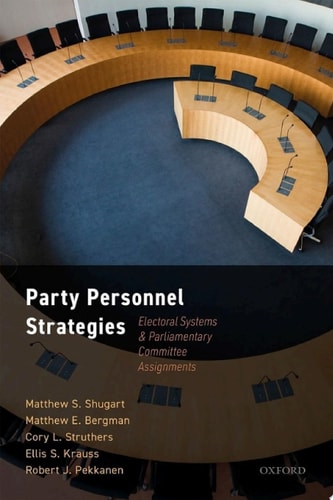
Party Personnel Strategies: Electoral Systems and Parliamentary Committee Assignments
0
0
As an Amazon Associate and affiliate partner, Menrva Books earns from qualifying purchases. Learn more
Author Description
Key party goals serve to advance a policy brand and maximize seats in the legislature. This book offers a theory of how political parties assign their elected members -- their "personnel" -- to specialized legislative committees to serve collective organizational goals, here known as "party personnel strategies". Individual party members vary in their personal attributes, such as prior occupation, gender, and local experience. Parties seek to harness the attributes of their members by assigning them to committees where their expertise is relevant, and where they may enhance the party's policy brand. However, under some electoral systems, parties may need to trade-off the harnessing of expertise against the pursuit of seats, instead matching legislators according to electoral situation (e.g. marginality of seat) or characteristics of their constituency (e.g. population density). This book offers an analysis of the extent to which parties trade these goals by matching the attributes of their personnel and their electoral needs to the functions of the available committee seats. The analysis is based on a dataset of around six thousand legislators across thirty-eight elections in six established parliamentary democracies with diverse electoral systems.
Menrva's Summary
THE THESIS
This book investigates how political parties strategically assign legislators to parliamentary committees to balance the competing goals of policy branding and electoral success. The authors, a team of political scientists, utilize a comprehensive dataset of six thousand legislators across six parliamentary democracies to construct a theory of "party personnel strategies." They argue that parties must navigate trade-offs between utilizing a member's specific professional expertise and addressing the electoral vulnerabilities of that member's constituency.
THE SCOPE MAP
What You Will Find
- A theoretical framework for understanding legislative committee assignments.
- Comparative analysis of six established parliamentary democracies.
- Quantitative assessment of legislator attributes including occupation, gender, and local experience.
Scope Limits
- The analysis is restricted to parliamentary systems and does not address presidential or hybrid systems.
- The study focuses on committee assignments rather than broader legislative behavior or floor voting patterns.
THE AUTHORITY PERSPECTIVE
Experts in comparative politics identify this work as a rigorous empirical contribution to the study of legislative organization. Readers frequently note the technical density of the statistical analysis, making it a specialized resource for scholars of political institutions.
Page Count:
326
Publication Date:
2021-01-01
Publisher:
OUP Oxford
ISBN-10:
0192651277
ISBN-13:
9780192651273
Legislative Studies
Parliamentary Studies
Comparative Politics
Electoral Systems
Community Tags
Similar Books