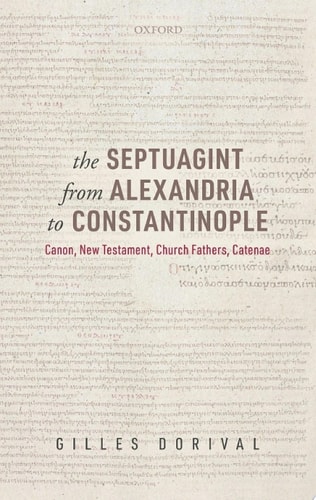
The Septuagint from Alexandria to Constantinople: Canon, New Testament, Church Fathers, Catenae
0
0
As an Amazon Associate and affiliate partner, Menrva Books earns from qualifying purchases. Learn more
Author Description
The Hebrew Torah was translated into Greek in Alexandria by Jewish scholars in the third century BCE, and other 'biblical' books followed to form the so-called Septuagint. Since the Septuagint contains a number of books and passages that are not part of the Hebrew Bible, the study of the Septuagint is essential to any account of the canon of the Hebrew Bible/Old Testament. However, the situation is complex because the Greek text of the Old Testament quoted in the New Testament and in the Church Fathers does not always match the Septuagint text as given by the earliest codices. Furthermore, it must be asked to what extent these texts of the Septuagint may have been Christianized. Up until the fifth century, the Old Testament of the Church Fathers was exclusively the Septuagint--except in the Syriac area--either in its Greek form or in a language translated from this Greek form. The Septuagint thus formed a much more important role in the building of Christian identity than it is usually recognised. After Jerome's Vulgate prevailed in the West, the Septuagint remained the reference text of the catenae. These Byzantine compilations of extracts of Patristic biblical commentary were produced first in Palestine, then in Constantinople and its dependancies between the sixth and fifteenth centuries and became the most important media for the transmission of patristic commentary in these centuries. The patristic extracts in the catenae provide a remarkable witness to the text of the Greek Old Testament as it was known and used by the Church Fathers.
Menrva's Summary
THE THESIS
This work investigates the historical development, transmission, and theological significance of the Septuagint from its origins in Alexandria through its role in Byzantine catenae. Gilles Dorival, a scholar of patristics and ancient texts, examines the complex relationship between the Greek Old Testament, the New Testament, and the writings of the Church Fathers. The author argues that the Septuagint served as a primary foundation for Christian identity and biblical interpretation long before and after the emergence of the Latin Vulgate.
THE SCOPE MAP
What You Will Find
- Historical analysis of the Septuagint's formation and its divergence from the Hebrew Bible.
- Examination of how the Septuagint was utilized and potentially Christianized by early Church Fathers.
- Detailed study of Byzantine catenae as vehicles for transmitting patristic commentary.
Scope Limits
- The text does not provide a comprehensive linguistic analysis of every variant reading within the codices.
- The study excludes detailed comparative analysis of the Syriac tradition, focusing primarily on the Greek and Byzantine spheres.
THE AUTHORITY PERSPECTIVE
Scholars recognize this text as a specialized contribution to the study of biblical transmission and patristic history. Readers frequently note the academic density of the prose, which is intended for those with a background in theology or classical studies.
Page Count:
235
Publication Date:
2021-01-01
Publisher:
OUP Oxford
ISBN-10:
0192652990
ISBN-13:
9780192652997
History
Religion
Ancient History
Influence Literary artistic etc
Versions
Church History
Bible
Catenae
Bibles
Patristics
Theology
Influence
Community Tags
Similar Books