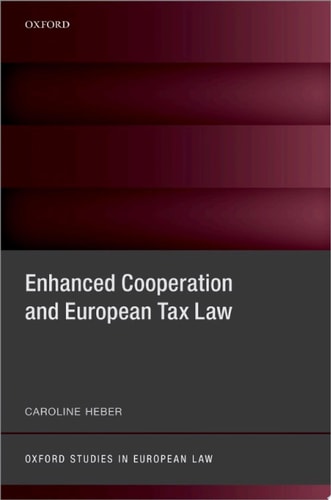
Enhanced Cooperation and European Tax Law
0
0
As an Amazon Associate and affiliate partner, Menrva Books earns from qualifying purchases. Learn more
Author Description
The Enhanced Cooperation Mechanism Allows At Least Nine Member States To Introduce Secondary Eu Law Which Is Only Binding Among These Member States. From An Internal Market Perspective, Enhanced Cooperation Laws Are Unique As They Lie Somewhere Between Unilateral Member State Laws And Uniform European Union Law. The Law Creates Harmonisation And Coordination Between The Participating Member States, But May Introduce Trade Obstacles In Relation To Non-participating Member States. This Book Reveals That The Enhanced Cooperation Mechanism Allows Member States To Protect Their Harmonised Values And Coordination Endeavours Against Market Efficiency.
Menrva's Summary
THE THESIS
This book investigates the legal and economic implications of the enhanced cooperation mechanism within the framework of European Union tax law. Caroline Heber, a scholar specializing in international and European tax law, analyzes how this mechanism functions as a hybrid between national legislation and uniform EU law. The text argues that while enhanced cooperation fosters harmonization among participating states, it simultaneously risks creating trade barriers that challenge the integrity of the internal market.
THE SCOPE MAP
What You Will Find
- Analysis of the enhanced cooperation mechanism as defined by the Treaty on the Functioning of the European Union
- Examination of the tension between market efficiency and national tax sovereignty
- Case studies on the implementation of secondary EU law in tax matters
Scope Limits
- Does not provide a comprehensive guide to individual national tax codes of all member states
- Does not cover non-tax related applications of enhanced cooperation
THE AUTHORITY PERSPECTIVE
Legal scholars and tax practitioners recognize this work as a rigorous examination of the intersection between EU integration and fiscal policy. The text is noted for its academic density and its contribution to the ongoing debate regarding the balance of power between participating and non-participating member states.
Page Count:
0
Publication Date:
2021-01-01
ISBN-10:
0192653326
ISBN-13:
9780192653321
Economics
Law
Tax Law
International Law
European Union