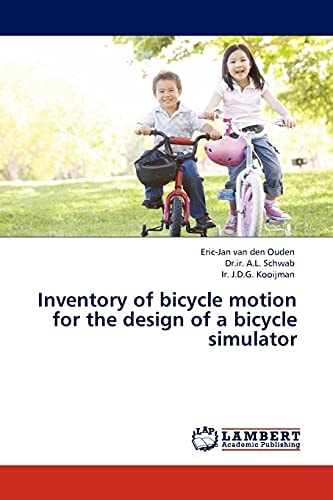
Inventory of Bicycle Motion for the Design of a Bicycle Simulator
0
0
As an Amazon Associate and affiliate partner, Menrva Books earns from qualifying purchases. Learn more
Author Description
Many parents worldwide teach their children to ride abicycle. Training wheels are method to help the childto get used to being on the bicycle. However theychange the dynamics an the control of a bicycledrastically. Nonetheless a regular child picks it uprelatively fast, although a few trials are inevitable.Not all childeren learn to ride a bicycle this way.Children with down syndrome for example often havetrouble losing the training wheels. They wouldgreatly benefit from the existence of a bicyclesimulator with adjustable stability. A bicyclesimulator would also be usefull for physicalrehabilitation purposes.Constructing a bicycle simulator however is achallenge. A bicycle is a dynamic system that ismore complex than one would expect. The largestchallenge is how could a bicyclesimulator be constructed and what are the hardwarerequirements in terms of steer torque, roll angle, rate and acceleration etc? The research done in orderto find these requirements is described in this report
Menrva's Summary
THE THESIS
This report investigates the dynamic complexities of bicycle motion to establish the hardware requirements for constructing a functional bicycle simulator. The authors address the challenge of teaching children, particularly those with Down syndrome, to ride bicycles, highlighting how training wheels alter bicycle dynamics. They propose a bicycle simulator as a tool for both learning to ride and for physical rehabilitation, acknowledging the significant engineering hurdles involved in creating such a device. The core of the research lies in determining the precise hardware specifications, such as steer torque and roll parameters, necessary for an effective simulator.
THE SCOPE MAP
- Analysis of bicycle dynamics and control mechanisms.
- Exploration of training wheels' impact on bicycle stability.
- Discussion of challenges in constructing a bicycle simulator.
- Identification of hardware requirements for adjustable stability.
- Consideration of steer torque, roll angle, rate, and acceleration parameters.
- Potential applications in child bicycle training and physical rehabilitation.
THE AUTHORITY PERSPECTIVE
This technical report details the research undertaken to define the parameters for a bicycle simulator. The work focuses on the engineering challenges and hardware specifications required for such a device, drawing on the dynamics of bicycle motion. It is presented as a foundational study for the design and construction of simulators, with potential applications in both learning and rehabilitation contexts.
Page Count:
124
Publication Date:
2011-07-01
Publisher:
Lap Lambert Academic Publishing GmbH KG
ISBN-10:
3844387692
ISBN-13:
9783844387698
Science & Technology
Non-Fiction
Biomechanics
Engineering
Robotics
Simulation
Community Tags
Similar Books