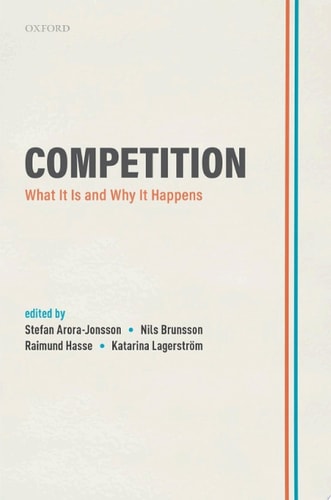
Competition: What It Is and Why It Happens
0
0
As an Amazon Associate and affiliate partner, Menrva Books earns from qualifying purchases. Learn more
Author Description
One of the predominant trends of modern society is the pervasive presence of competition. No longer just a function of economic markets or democratic systems, competition has become a favoured tool for governing people and organizations, from the provision of schooling and elder care to the way we consume popular culture. Yet social scientists have played a surprisingly modest role in analysing its implications, as the discussion of competition has largely been confined to its narrow economic meaning. This book opens up competition for the study of social scientists. Its central message is that while competition seems ubiquitous, it should not be taken for granted or be naturalized as an inevitable aspect of human existence. Its emergence, maintenance, and change are based on institutions and organizational efforts, and a central challenge for social science is to learn more about these processes and their outcomes. With the use of a novel definition of competition, more fundamental questions can be addressed than merely whether or not competition works. How is competition constructed - and by whom? Which behaviours result from competition? What are its consequences? Can competition be removed? And, how do these factors vary with the object of competition - be it money, attention, status, or other scarce and desired objects? This book investigates these and more questions in studies of competition among and within schools, universities, multinational corporations, auditors, waste-disposal firms, fashion designers, and more.
Menrva's Summary
THE THESIS
This book investigates the pervasive role of competition in modern society, questioning whether it is an inevitable human condition or a constructed institutional mechanism. The authors, representing the analytical rigor of the Harvard Business Review, challenge the narrow economic interpretation of competition by examining it through a sociological lens. They argue that competition is a deliberate organizational tool that requires systematic study to understand its origins, maintenance, and societal consequences.
THE SCOPE MAP
What You Will Find
- A novel definition of competition that extends beyond market dynamics
- Analysis of competition within diverse sectors including education, fashion, and corporate auditing
- Examination of competition for non-monetary resources like status and attention
Scope Limits
- Does not provide a prescriptive guide for winning competitive markets
- Avoids simplistic binary arguments regarding the success or failure of competitive systems
THE AUTHORITY PERSPECTIVE
Experts recognize this text as a significant contribution to the sociological study of organizational behavior. Readers frequently note the academic density of the prose, which serves as a foundational resource for those interested in the institutional construction of modern social systems.
Page Count:
256
Publication Date:
2021-01-01
Publisher:
OUP Oxford
ISBN-10:
0192652869
ISBN-13:
9780192652867
Business
Economics
Sociology
Social Science
Community Tags
Similar Books