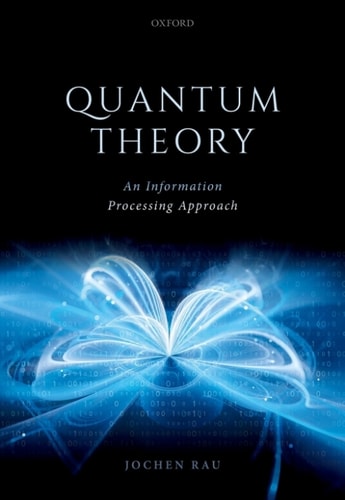
Quantum Theory: An Information Processing Approach
0
0
As an Amazon Associate and affiliate partner, Menrva Books earns from qualifying purchases. Learn more
Author Description
Recent advances in quantum technology - from quantum computers and simulators to secure communication and metrology - have not only opened up a whole new world of practical applications but also changed our understanding of quantum theory itself. This text, for the first time, introduces quantum theory entirely from this new perspective. It does away with the traditional approach to quantum theory as a theory of microscopic matter, and instead focuses on quantum theory as a framework for information processing. Accordingly, the emphasis is on concepts like measurement, probability, statistical correlations, and transformations, rather than on waves and particles. This affords a simple, direct route to quantum theory, all the way to some of its most fascinating conceptual issues. Since it requires only minimal mathematics and virtually no prior knowledge of physics, it is accessible to younger undergraduates and students of neighbouring disciplines. The text offers a unique blend of insights both into the physical foundations and the practical application of quantum theory. It begins with a discussion of experimental evidence that forces us to abandon the classical description and to critically re-examine such basic notions as measurement, probability, and state. The thorough investigation of these concepts leads to the alternative framework of quantum theory, set in complex Hilbert space. The requisite mathematics is developed carefully and always linked to its operational meaning. This part of the text culminates in an exploration of some of the most vexing foundational issues of quantum theory, regarding locality, non-contextuality, and realism. The second half of the text explains how the peculiar features of quantum theory may be harnessed to tackle information processing tasks that are intractable or even impossible classically. It provides the essential tools for understanding and designing the pertinent protocols, and discusses a diverse range of examples.
Menrva's Summary
THE THESIS
This book investigates whether quantum theory can be more effectively understood as a framework for information processing rather than a traditional theory of microscopic matter. Author Jochen Rau, drawing on his background in physics, presents a pedagogical approach that prioritizes operational concepts such as measurement, probability, and statistical correlations. By shifting the focus away from wave-particle duality, the text provides a streamlined conceptual path for students and researchers to grasp the foundations of quantum mechanics.
THE SCOPE MAP
What You Will Find
- A framework for quantum theory based on complex Hilbert space
- Analysis of foundational issues including locality, non-contextuality, and realism
- Methodologies for applying quantum features to information processing tasks
- Mathematical development linked directly to operational meaning
Scope Limits
- Does not provide an exhaustive history of traditional wave-particle physics
- Requires basic mathematical literacy despite the accessible entry point
THE AUTHORITY PERSPECTIVE
Experts highlight this text as a valuable resource for undergraduates and students in neighboring disciplines who require a modern, information-centric introduction to quantum mechanics. Readers frequently note that the prose remains accessible while maintaining the necessary rigor for understanding complex foundational issues.
Page Count:
264
Publication Date:
2021-01-01
Publisher:
OUP Oxford
ISBN-10:
0192650270
ISBN-13:
9780192650276
Science
Physics
Information Theory
Earth Sciences
Academic
Community Tags
Similar Books