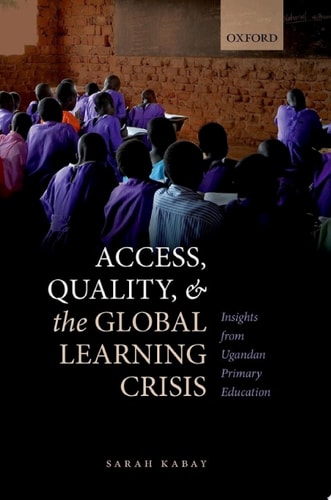
Access, Quality, and the Global Learning Crisis: Insights from Ugandan Primary Education
0
0
As an Amazon Associate and affiliate partner, Menrva Books earns from qualifying purchases. Learn more
Author Description
Around the world, 250 million children cannot read, write, or perform basic mathematics. They represent almost 40% of all primary school-aged children. This situation has come to be called the "global learning crisis" and it is one of the most critical challenges facing the world today. Work to address this situation depends on how it is understood. Typically, the global learning crisis and efforts to improve primary education are defined in relation to two terms: access and quality. This book is focused on the connection between them. Through a mixed-methods case study, it provides detailed, contextualized analysis of Ugandan primary education. As one of the first countries in Sub-Saharan Africa to enact dramatic and far-reaching primary education policy, Uganda serves as a compelling case study. With both quantitative and qualitative data from over 400 Ugandan schools and communities, the book analyzes grade repetition, private primary schools, and school fees, viewing each issue as an illustration of the connection between access to education and education quality. This analysis finds evidence of a positive association, challenging a key assumption that there is a trade-off or disconnect between efforts to improve access to education and efforts to improve education quality. Embracing the complexity of education systems, and focusing on dynamics where improvements in access and quality can be mutually reinforcing, can be a new approach for improving basic education in different contexts around the world.
Menrva's Summary
THE THESIS
This book investigates the relationship between access to primary education and the quality of learning outcomes within the context of the global learning crisis. Sarah Kabay, an expert in international education policy, utilizes a mixed-methods approach to examine the Ugandan primary education system. By analyzing data from over 400 schools, the author challenges the prevailing assumption that increasing access to schooling necessarily compromises the quality of education provided to students.
THE SCOPE MAP
What You Will Find
- Quantitative and qualitative data sets from 400 Ugandan schools and communities
- Analysis of systemic factors including grade repetition, private school expansion, and school fee structures
- A framework for understanding how access and quality can function as mutually reinforcing variables
Scope Limits
- The analysis is geographically restricted to the Ugandan primary education system
- The text does not provide a comprehensive global policy manual, focusing instead on the specific case study of Uganda
THE AUTHORITY PERSPECTIVE
Experts recognize this work as a significant contribution to development studies for its empirical challenge to the access-versus-quality trade-off model. Readers frequently note the academic rigor of the mixed-methods analysis, making it a valuable resource for policymakers and researchers focusing on Sub-Saharan African education systems.
Page Count:
194
Publication Date:
2021-01-01
Publisher:
OUP Oxford
ISBN-10:
0192650750
ISBN-13:
9780192650757
Economics
Sociology
Public Policy
Africa
Administration & Supervision
Education
Professional Career & Trade
Education - History
Community Tags
Similar Books



![Instructor's manual and test bank [for] money and banking: A market-oriented approach](https://storage.googleapis.com/menrva_img_storage/covers/generated/9780030012235.jpg)