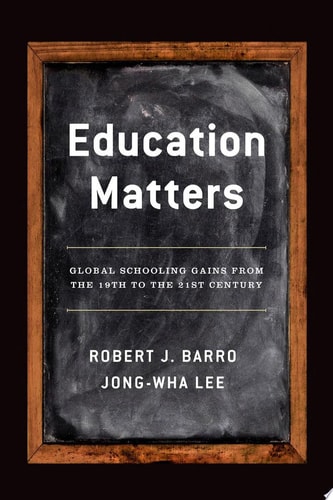
Education Matters: Global Schooling Gains from the 19th to the 21st Century
0
0
As an Amazon Associate and affiliate partner, Menrva Books earns from qualifying purchases. Learn more
Author Description
Education has significant and far-reaching effects not only on individuals, but also on the societies in which they live and to which they contribute. The education level of a population affects how a country supports itself and others and the degree to which it can participate in the global field. While everyone from politicians to policymakers to celebrities has stressed the importance of education, there has not been-until now-a vigorous yet comprehensible examination of data to support what has long been common knowledge: education matters. In Education Matters: Global Gains from the 19th to the 21st Century, renowned economists Robert Barro and Jong-Wha Lee present a revolutionary new data set on education in 146 countries since 1870 and projected through 2040. With case studies from the United States, China, and Korea, Barro and Lee evaluate schooling both quantitatively and qualitatively, and assess the role of education in economic and political development. In this comprehensive study, the authors establish the critical role that education plays - particularly for women and girls - in economic growth, fertility, and democracy. The book also addresses sensitive and controversial topics, such as international disparities in education, and the role of education in modernization and development. Both challenging and enlightening, Education Matters has exciting implications for the future of education and promises to be a ground-breaking work in the fields of economics and educational attainment. Engaging and informative, Education Matters is a compelling read for students, scholars, and anyone with a passion for education.
Menrva's Summary
THE THESIS
This work investigates the long-term correlation between educational attainment and global economic, political, and social development from the 19th century to the present. Economists Robert J. Barro and Jong-Wha Lee utilize an extensive, multi-national data set to quantify the impact of schooling on national prosperity and democratic stability. By analyzing historical trends and projecting future outcomes, the authors provide a rigorous framework for understanding how human capital investment shapes the trajectory of modern societies.
THE SCOPE MAP
What You Will Find
- A comprehensive data set covering educational attainment across 146 countries from 1870 to 2040.
- Comparative case studies focusing on the United States, China, and Korea.
- Quantitative analysis of the relationship between schooling, fertility rates, and economic growth.
- Qualitative assessment of the role of education in fostering democracy and modernization.
THE AUTHORITY PERSPECTIVE
Experts recognize this text as a foundational resource for researchers examining the intersection of human capital and macroeconomic development. Readers frequently note the academic density of the prose and the significant value of the longitudinal data provided for comparative policy analysis.
Page Count:
303
Publication Date:
2015-01-01
Publisher:
Oxford University Press
ISBN-10:
0199379254
ISBN-13:
9780199379255
Economics
History
Consumer Education
Special Topics
Educational Foundations
Economics history
Professional Career & Trade
Public Policy
Education
Sociology
Community Tags
Similar Books