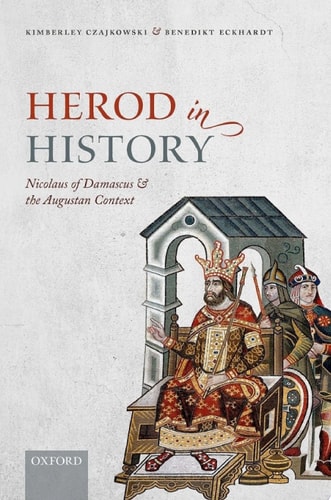
Herod in History: Nicolaus of Damascus and the Augustan Context
0
0
As an Amazon Associate and affiliate partner, Menrva Books earns from qualifying purchases. Learn more
Author Description
Most of our information about Herod the Great derives from the accounts found in Josephus' Jewish War and Jewish Antiquities. Together they constitute a unique resource on one of the most famous personalities of ancient history. But from where did Josephus get his information? It is commonly agreed that his primary source was Nicolaus of Damascus, Herod's court historian, though the extent to which Josephus adapted his material remains disputed. Herod in History takes a modern, source-critical approach to Josephus' extensive account of Herod's reign to suggest that Josephus did indeed rely heavily on Nicolaus's work, but that previous scholarship was mistaken in seeing Nicolaus as a mere propagandist. Nicolaus may have begun his Universal History while Herod was alive, but he finished it after his death and so had no reason to write propaganda. This makes his work all the more interesting, for what we have instead is something rather different: a Syrian intellectual claiming a place in Augustan Rome, by telling a story about what the Augustan World looks like on the Eastern periphery. Kimberley Czajkowski and Benedikt Eckhardt delineate Nicolaus' approach to various critical topics in Herod's reign in order to reveal his perception of client kingship, the impact of empire, and the difficulties involved in ruling Judaea. This study uncovers an Eastern intellectual's view on how to succeed and how to fail in the new Augustan world order.
Menrva's Summary
THE THESIS
This study investigates the extent to which the historian Nicolaus of Damascus served as the primary source for Josephus' accounts of Herod the Great and re-evaluates the nature of Nicolaus' historical writing. Authors Benedikt Eckhardt and Kimberley Czajkowski utilize source-critical methodology to challenge the long-standing academic consensus that Nicolaus functioned merely as a propagandist for the Herodian court. By analyzing the timeline of Nicolaus' Universal History, the authors argue that his work reflects the perspective of a Syrian intellectual navigating the complexities of the Augustan world order rather than simple court-sanctioned bias.
THE SCOPE MAP
What You Will Find
- A detailed source-critical analysis of Josephus' Jewish War and Jewish Antiquities.
- An examination of the political and cultural role of Nicolaus of Damascus within the Roman Empire.
- Discussions on the mechanics of client kingship and the administration of Judaea under Augustan influence.
Scope Limits
- The book does not provide a comprehensive biography of Herod the Great independent of his historiographical representation.
- It does not offer a complete reconstruction of the lost Universal History of Nicolaus.
THE AUTHORITY PERSPECTIVE
Scholars in the field of classical history recognize this work as a significant contribution to the study of ancient historiography and the reception of Herodian history. Readers frequently note the academic density of the prose, which is intended for specialists in ancient history and those interested in the intersection of Roman imperial politics and Eastern intellectual life.
Page Count:
204
Publication Date:
2021-01-01
Publisher:
OUP Oxford
ISBN-10:
0192659839
ISBN-13:
9780192659835
History
Biography
Middle Eastern
Ancient History
Asia history
Historiography
Community Tags
Similar Books