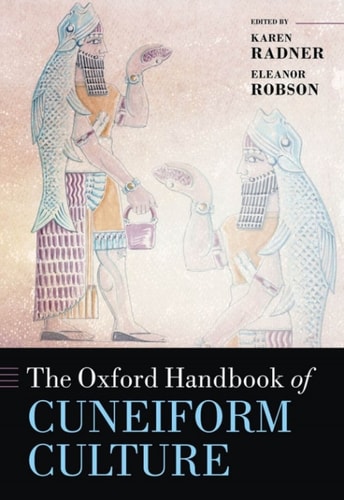
The Oxford Handbook of Cuneiform Culture
0
0
As an Amazon Associate and affiliate partner, Menrva Books earns from qualifying purchases. Learn more
Author Description
The cuneiform script, the writing system of ancient Mesopotamia, was witness to one of the world's oldest literate cultures. For over three millennia, it was the vehicle of communication from (at its greatest extent) Iran to the Mediterranean, Anatolia to Egypt. The Oxford Handbook of Cuneiform Culture examines the Ancient Middle East through the lens of cuneiform writing. The contributors, a mix of scholars from across the disciplines, explore, define, and to some extent look beyond the boundaries of the written word, using Mesopotamia's clay tablets and stone inscriptions not just as 'texts' but also as material artefacts that offer much additional information about their creators, readers, users and owners.
Menrva's Summary
THE THESIS
This volume investigates the role of cuneiform script as a foundational element of ancient Mesopotamian society and its broader cultural influence across three millennia. Editors Eleanor Robson and Karen Radner assemble a diverse group of scholars to analyze clay tablets and stone inscriptions not merely as linguistic records, but as material artifacts that reveal the social, economic, and political lives of their creators and users. The work employs an interdisciplinary framework to bridge the gap between philology and archaeology, providing a comprehensive view of the literate cultures of the Ancient Middle East.
THE SCOPE MAP
What You Will Find
- Analysis of cuneiform as a vehicle for communication across Iran, the Mediterranean, Anatolia, and Egypt
- Methodologies for interpreting tablets as material objects rather than just textual sources
- Studies on the social history of scribes, readers, and owners of cuneiform documents
Scope Limits
- The text focuses primarily on the cultural and material aspects of cuneiform rather than providing a comprehensive linguistic grammar or dictionary
- It does not cover the entirety of Mesopotamian history in a chronological narrative format
THE AUTHORITY PERSPECTIVE
Scholars and students of Assyriology frequently cite this handbook as a standard reference for understanding the socio-cultural context of ancient writing systems. Experts highlight the volume for its successful integration of material culture with traditional textual analysis, making it a foundational resource for researchers in the field.
Page Count:
848
Publication Date:
2011-01-01
Publisher:
OUP Oxford
ISBN-10:
019161761X
ISBN-13:
9780191617614
History
Anthropology
Archaeology
Linguistics
Near East
Language Arts
Middle Eastern
Reference
Asia history
English & College Success
English
Ancient History
Civilization Assyro-Babylonian
Community Tags
Similar Books