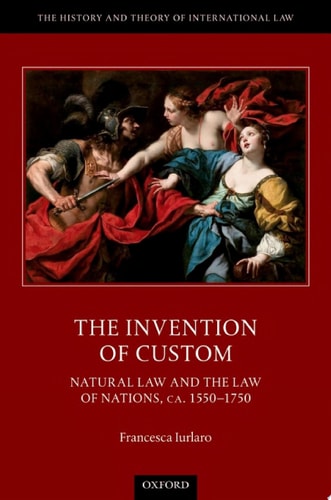
The Invention of Custom: Natural Law and the Law of Nations, ca. 1550-1750
0
0
As an Amazon Associate and affiliate partner, Menrva Books earns from qualifying purchases. Learn more
Author Description
The concept of customary international law, although differently formulated, is already present in early modern European debates on natural law and the law of nations. However, no scholarly monograph has, until now, addressed the relationship between custom and the European natural law and ius gentium tradition. This book tells that neglected story, and offers a solid conceptual framework to contextualize and understand the 'problematic of custom', namely how to identify its normative content. Natural law doctrines, and the different ways in which they help construct human reason, provided custom with such normative content. This normative content consists of a set of fundamental moral values that help identify the status of custom as either a fundamental feature or an original source of ius gentium. This book explores what cultural values and practices facilitated the emergence of custom and rendered it into as a source of the law of nations, and how they did so. Two crucial issues form the core of the book's analysis. Firstly, it qualifies the nature of the interrelation between natural law and ius gentium, explaining why it matters in relation to our understanding of the idea of custom. Second, the book claims that the process of custom formation as a source of law calls into question the role of the authority of history. The interpretation of the past through this approach can thus be described as one of 'invention'.
Menrva's Summary
THE THESIS
This book investigates how early modern European thinkers conceptualized the normative content of customary international law within the framework of natural law and the law of nations. Francesca Iurlaro, a scholar of legal history, examines the intellectual evolution of 'custom' between 1550 and 1750. She argues that natural law doctrines were essential in providing the moral foundation for custom, effectively transforming historical practices into recognized legal sources. By analyzing the intersection of human reason and historical precedent, the author demonstrates how the authority of history was actively constructed or 'invented' to legitimize international legal norms.
THE SCOPE MAP
What You Will Find
- An analysis of the intellectual history of ius gentium from 1550 to 1750.
- A conceptual framework for identifying the normative content of custom.
- An examination of the relationship between natural law doctrines and customary law.
- A critique of the role of historical authority in legal formation.
Scope Limits
- The study focuses primarily on European legal thought and does not provide a global comparative analysis of non-Western legal traditions.
- The book does not address modern post-1750 developments in international law.
THE AUTHORITY PERSPECTIVE
Scholars in the field of legal history recognize this work as a significant contribution to the understanding of early modern international law. Readers frequently note the academic density of the prose and the rigorous archival research used to support the author's claims.
Page Count:
293
Publication Date:
2021-01-01
Publisher:
OUP Oxford
ISBN-10:
0192652826
ISBN-13:
9780192652829
History
Professional Career & Trade
International Law
European History
Natural law
Legal Theory
Political Philosophy
Community Tags
Similar Books