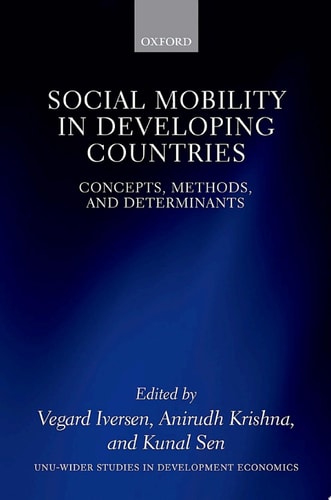
Social Mobility in Developing Countries: Concepts, Methods, and Determinants
0
0
As an Amazon Associate and affiliate partner, Menrva Books earns from qualifying purchases. Learn more
Author Description
Social mobility is the hope of economic development and the mantra of a good society. There are disagreements about what constitutes social mobility, but there is broad agreement that people should have roughly equal chances of success regardless of their economic status at birth. Concerns about rising inequality have engendered a renewed interest in social mobility--especially in the developing world. However, efforts to construct the databases and meet the standards required for conventional analyses of social mobility are at a preliminary stage and need to be complemented by innovative, conceptual, and methodological advances. If forms of mobility have slowed in the West, then we might be entering an age of rigid stratification with defined boundaries between the always-haves and the never-haves-which does not augur well for social stability. Social mobility research is ongoing, with substantive findings in different disciplines--typically with researchers in isolation from each other. A key contribution of this book is the pulling together of the emerging streams of knowledge. Generating policy-relevant knowledge is a principal concern. Three basic questions frame the study of diverse aspects of social mobility in the book. How to assess the extent of social mobility in a given development context when the datasets by conventional measurement techniques are unavailable? How to identify drivers and inhibitors of social mobility in particular developing country contexts? How to acquire the knowledge required to design interventions to raise social mobility, either by increasing upward mobility or by lowering downward mobility?
Menrva's Summary
THE THESIS
This book investigates how social mobility can be accurately measured, understood, and improved within the unique constraints of developing nations. Christian Giudice synthesizes emerging research streams to address the lack of conventional data in developing contexts. The work provides a conceptual and methodological framework designed to help policymakers identify drivers of mobility and design effective interventions to foster upward social movement.
THE SCOPE MAP
What You Will Find
- Methodological approaches for assessing mobility when conventional datasets are absent
- Analysis of the drivers and inhibitors of social mobility in diverse developing country contexts
- Frameworks for designing policy interventions to increase upward mobility
Scope Limits
- Does not provide a singular, universal policy solution for all developing nations
- Does not cover historical mobility trends in developed Western economies in exhaustive detail
THE AUTHORITY PERSPECTIVE
Experts recognize this text as a valuable synthesis for researchers working in isolation across different disciplines. Readers frequently note that the book serves as a foundational resource for those attempting to bridge the gap between theoretical economic concepts and practical policy application in developing regions.
Page Count:
505
Publication Date:
2021-01-01
Publisher:
OUP Oxford
ISBN-10:
0192650734
ISBN-13:
9780192650733
Economics
Sociology
Social Science
Public Policy
Community Tags
Similar Books