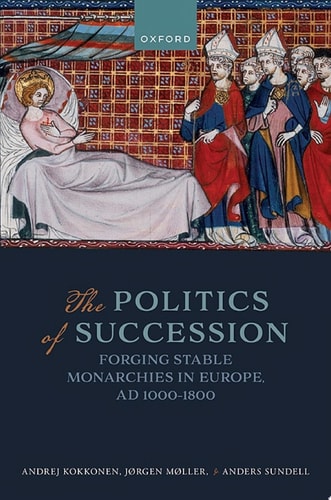
The Politics of Succession: Forging Stable Monarchies in Europe, AD 1000-1800
0
0
As an Amazon Associate and affiliate partner, Menrva Books earns from qualifying purchases. Learn more
Author Description
The death of the ruler poses a significant threat to the stability of any polity. Arranging for a peaceful and orderly succession has been a formidable challenge in most historical societies, and it continues to be a test that modern authoritarian regimes regularly face and often fail. Drawing on a unique dataset of the life and fates of monarchs in all major monarchies in Medieval and Early Modern Europe, The Politics of Succession documents how succession have historically been moments of violence and insecurity. Deaths of rulers were often associated with civil war, and the shadow cast by looming successions caused coups and depositions. But this book also shows that the development and spread of primogeniture - the eldest-son-taking-the-throne - mitigated the problem of succession in Europe in the period after AD 1000. The predictability and stability that followed from a clear hereditary principle outweighed the problems of incompetent and irrational rulers sometimes inheriting power. The data used in the book demonstrates that primogeniture reduced the risk of depositions and civil war following the inevitable deaths of leaders. In this way, hereditary monarchy helped create political stability and lengthen the time horizons of rulers and elites alike, thereby facilitating state-building. The book thus sheds light on the rationale of a system of leader selection that today often appears illogical and outdated - and it uses these findings to shed light on the key advantage of modern representative democracy: its ability to complete power transfers peacefully.
Menrva's Summary
THE THESIS
This book investigates how the institutionalization of hereditary succession, specifically primogeniture, functioned as a mechanism to stabilize European monarchies between AD 1000 and 1800. The authors, political scientists Anders Sundell, Andrej Kokkonen, and Jørgen Møller, utilize a comprehensive dataset tracking the life and fates of monarchs across major European states. They argue that while hereditary rule often resulted in incompetent leadership, the predictability it provided significantly reduced the frequency of civil wars and coups, thereby fostering long-term state-building.
THE SCOPE MAP
What You Will Find
- A longitudinal analysis of monarchical succession patterns in Europe from AD 1000 to 1800.
- Quantitative data regarding the correlation between succession rules and the incidence of civil war or deposition.
- A comparative framework linking historical monarchical stability to the mechanisms of modern democratic power transfers.
Scope Limits
- The analysis is restricted to European monarchies and does not provide a global survey of non-European succession systems.
- The study focuses primarily on political stability and state-building outcomes rather than the cultural or religious justifications for divine right.
THE AUTHORITY PERSPECTIVE
Scholars in political science and historical institutionalism view this work as a rigorous application of quantitative methods to long-term political history. Readers frequently note the academic density of the prose, which serves as a foundational text for understanding the evolution of political stability in pre-modern states.
Page Count:
406
Publication Date:
2022-01-01
Publisher:
OUP Oxford
ISBN-10:
0192651943
ISBN-13:
9780192651945
History
European History
Middle Ages
Monarchy
History - Modern
Community Tags
Similar Books