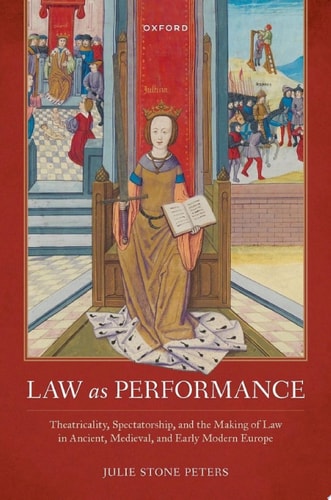
Law as Performance: Theatricality, Spectatorship, and the Making of Law in Ancient, Medieval, and Early Modern Europe
0
0
As an Amazon Associate and affiliate partner, Menrva Books earns from qualifying purchases. Learn more
Author Description
Tirades against legal theatrics are nearly as old as law itself, and yet so is the age-old claim that law must not merely be done: it must be "seen to be done." Law as Performance traces the history of legal performance and spectatorship through the early modern period. Viewing law as the product not merely of edicts or doctrines but of expressive action, it investigates the performances that literally created law: in civic arenas, courtrooms, judges' chambers, marketplaces, scaffolds, and streets. It examines the legal codes, learned treatises, trial reports, lawyers' manuals, execution narratives, rhetoric books, images (and more) that confronted these performances, praising their virtues or denouncing their evils. In so doing, it recovers a long, rich, and largely overlooked tradition of jurisprudential thought about law as a performance practice. This tradition not only generated an elaborate poetics and politics of legal performance. It provided western jurisprudence with a set of constitutive norms that, in working to distinguish law from theatrics, defined the very nature of law. In the crucial opposition between law and theatre, law stood for cool deliberation, by-the-book rules, and sovereign discipline. Theatre stood for deceptive artifice, entertainment, histrionics, melodrama. And yet legal performance, even at its most theatrical, also appeared fundamental to law's realization: a central mechanism for shaping legal subjects, key to persuasion, essential to deterrence, indispensable to law's power, —as it still does today.
Menrva's Summary
THE THESIS
This book investigates the historical tension between law and theatricality, questioning how the performative nature of legal proceedings has shaped the definition and legitimacy of law in Western jurisprudence. Julie Stone Peters, a scholar of law and literature, utilizes a vast array of historical documents—including trial reports, legal treatises, and execution narratives—to argue that law is not merely a collection of doctrines but a product of expressive, public action. She posits that the persistent effort to distinguish law from theatre has paradoxically defined the core norms and sovereign power of the legal system itself.
THE SCOPE MAP
What You Will Find
- Historical analysis of legal performance from ancient through early modern Europe.
- Examination of diverse venues including civic arenas, courtrooms, and public scaffolds.
- Analysis of primary sources such as lawyers' manuals, rhetoric books, and execution narratives.
- A theoretical framework exploring the dichotomy between 'cool deliberation' and 'deceptive artifice.'
Scope Limits
- The study focuses primarily on European legal traditions and does not extend into contemporary global legal systems.
- The work prioritizes the intersection of law and performance over a comprehensive history of substantive legal doctrine.
THE AUTHORITY PERSPECTIVE
Scholars in the fields of legal history and performance studies identify this work as a significant contribution to the understanding of law as a cultural practice. Readers frequently note the academic density of the prose and the breadth of the archival research presented by the author.
Page Count:
366
Publication Date:
2022-01-01
Publisher:
OUP Oxford
ISBN-10:
0192653598
ISBN-13:
9780192653598
European History
Jurisprudence
Legal History
Cultural History
Law and literature
Performance Studies
English
English & College Success