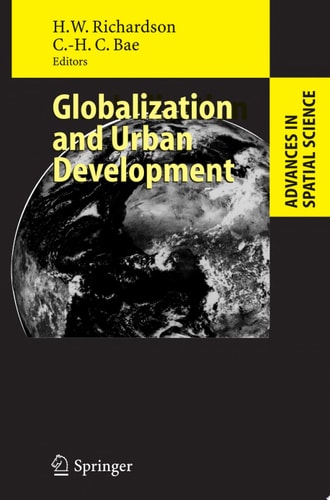
Globalization and Urban Development
0
0
As an Amazon Associate and affiliate partner, Menrva Books earns from qualifying purchases. Learn more
Author Description
Most research on globalization has focused on macroeconomic and economy-wide consequences. This book explores an under-researched area, the impacts of globalization on cities and national urban hierarchies, especially but not solely in developing countries. Most of the globalization-urban research has concentrated on the "global cities" (e.g. New York, London, Paris, Tokyo) that influence what happens in the rest of the world. In contrast, this research looks at the cities at the receiving end of the forces of globalization. The general finding is that large cities, on balance, benefit from globalization, although in some cases at the expense of widening spatial inequities.
Menrva's Summary
THE THESIS
This book investigates the often-overlooked impacts of globalization on cities and national urban hierarchies, particularly in developing nations. While much research has focused on the macroeconomic effects of globalization, this work shifts the lens to examine how cities at the receiving end of global forces are affected. The authors present findings that suggest large cities generally benefit from globalization, though this can sometimes exacerbate spatial inequalities within them.
THE SCOPE MAP
- Analysis of globalization's effects on cities beyond the traditional "global cities".
- Focus on urban hierarchies and their transformation under global economic pressures.
- Examination of both benefits and drawbacks of globalization for urban centers.
- Exploration of spatial inequities arising from global economic integration.
- Case studies and data primarily from developing countries.
- Discussion of the role of cities in the global economic system.
THE AUTHORITY PERSPECTIVE
This book is recognized for its crucial examination of globalization's impact on urban development, moving beyond the focus on major global hubs to investigate cities that are recipients of these forces. The research indicates that while large cities tend to gain from globalization, this often comes at the cost of increased internal spatial disparities. The work provides a valuable perspective for understanding the nuanced relationship between global economic trends and urban structures, especially in the context of developing economies.
Page Count:
322
Publication Date:
2006-03-30
Publisher:
Springer Nature
ISBN-10:
354028351X
ISBN-13:
9783540283515
Non-Fiction
Economics
History
Globalization
Urban Studies
Economic Geography
Community Tags
Similar Books