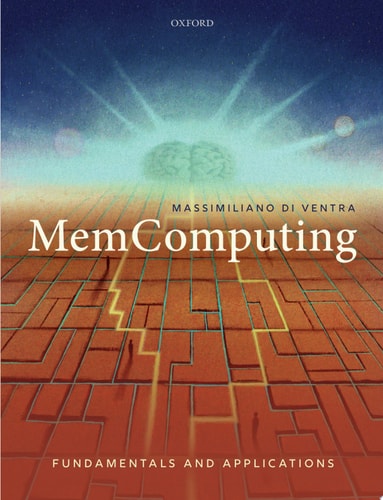
MemComputing: Fundamentals and Applications
0
0
As an Amazon Associate and affiliate partner, Menrva Books earns from qualifying purchases. Learn more
Author Description
MemComputing is a new computing paradigm that employs time non-locality (memory) to both process and store information. This book, written by the originator of this paradigm, explains the main ideas behind MemComputing, explores its theoretical foundations, and shows its applicability to a wide variety of combinatorial optimization problems, machine learning, and quantum mechanics. The book is ideal for graduate students in Physics, Computer Science, Electrical Engineering, and Mathematics, as well as researchers in both academia and industry interested in unconventional computing. The author relies on extensive margin notes, important remarks, and many illustrations to better explain the main concepts and clarify jargon, making the book as self-contained as possible. The reader will be guided from the basic notions to the more advanced ones with an always clear and engaging writing style. Along the way, the reader will appreciate the advantages of this computing paradigm and the major differences that set it apart from the prevailing Turing model of computation, and even quantum computing.
Menrva's Summary
THE THESIS
This book investigates the theoretical framework and practical utility of MemComputing, a novel paradigm that utilizes time non-locality to integrate information processing and storage. Massimiliano Di Ventra, the originator of this field, draws upon his extensive research in condensed matter physics and non-equilibrium statistical mechanics to present a comprehensive overview. The text argues that MemComputing offers distinct advantages over the traditional Turing model and quantum computing by leveraging memory-based dynamics to solve complex combinatorial optimization and machine learning problems.
THE SCOPE MAP
What You Will Find
- Theoretical foundations of time non-locality in computing systems
- Applications in combinatorial optimization and machine learning
- Comparative analysis between MemComputing, Turing machines, and quantum computing
- Pedagogical aids including margin notes, remarks, and technical illustrations
Scope Limits
- Does not provide a comprehensive history of general computing beyond the Turing model
- Focuses primarily on the author's specific paradigm rather than broad surveys of all unconventional computing methods
THE AUTHORITY PERSPECTIVE
Experts and academics recognize this work as the foundational text for understanding the mechanics of MemComputing. Readers frequently note the technical density of the prose, which is balanced by the author's inclusion of explanatory margin notes and clear illustrations.
Page Count:
360
Publication Date:
2022-01-01
Publisher:
OUP Oxford
ISBN-10:
0192659898
ISBN-13:
9780192659897
Combinatorics
Engineering
Mathematics Statistics
Post-Calculus
Mathematics
Physics
Computer Science
Computational Theory
Unconventional Computing
Community Tags
Similar Books