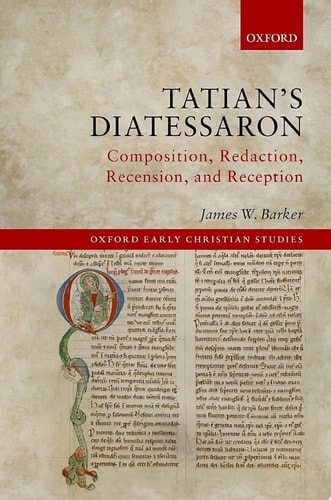
Tatian's Diatessaron: Composition, Redaction, Recension, and Reception
0
0
As an Amazon Associate and affiliate partner, Menrva Books earns from qualifying purchases. Learn more
Author Description
In the late-second century, Tatian the Assyrian constructed a new Gospel by intricately harmonizing Matthew, Mark, Luke, and John. Tatian's work became known as the Diatessaron, since it was derived 'out of the four' eventually canonical Gospels. Though it circulated widely for centuries, the Diatessaron disappeared in antiquity. Nevertheless, numerous ancient and medieval harmonies survive in various languages. Some texts are altogether independent of the Diatessaron, while others are definitely related. Yet even Tatian's known descendants differ in large and small ways, so attempts at reconstruction have proven confounding. In this book James W. Barker forges a new path in Diatessaron studies. Covering the widest array of manuscript evidence to date, Tatian's Diatessaron reconstructs the compositional and editorial practices by which Tatian wrote his Gospel. By sorting every extant witnesses according to its narrative sequence, the macrostructure of Tatian's Gospel becomes clear. Despite many shared agreements, there remain significant divergences between eastern and western witnesses. This book argues that the eastern ones preserve Tatian's order, whereas the western texts descend from a fourth-century recension of the Diatessaron. Victor of Capua and his scribe used the recension to produce the Latin Codex Fuldensis in the sixth century. More controversially, Barker offers new evidence that late medieval texts such as the Middle Dutch Stuttgart harmony independently preserve traces of the western recension. This study uncovers the composition and reception history behind one of early Christianity's most elusive texts.
Menrva's Summary
THE THESIS
This book investigates the compositional history, editorial methodology, and complex reception of Tatian's second-century Gospel harmony, the Diatessaron. James W. Barker, a scholar of early Christian texts, utilizes a comprehensive analysis of extant manuscript evidence to resolve long-standing questions regarding the original structure of the work. By categorizing witnesses based on narrative sequence, Barker argues that eastern manuscripts preserve Tatian's original order, while western versions derive from a distinct fourth-century recension.
THE SCOPE MAP
What You Will Find
- A comparative analysis of eastern and western manuscript witnesses of the Diatessaron.
- A reconstruction of Tatian's editorial practices and macrostructure.
- Evidence linking the Latin Codex Fuldensis to a specific fourth-century recension.
- Examination of late medieval texts, including the Middle Dutch Stuttgart harmony.
Scope Limits
- The study does not provide a complete word-for-word reconstruction of the original Greek Diatessaron.
- It does not focus on the theological implications of the harmony's content, prioritizing structural and historical analysis instead.
THE AUTHORITY PERSPECTIVE
Scholars in the field of early Christian studies recognize this work as a significant contribution to the understanding of Gospel harmonies and their transmission history. Readers frequently note the technical density of the prose and the rigorous methodology applied to the manuscript evidence.
Page Count:
165
Publication Date:
2021-01-01
Publisher:
OUP Oxford
ISBN-10:
019265893X
ISBN-13:
9780192658937
History
Religion
Bible
Theology
Christianity
Community Tags
Similar Books