
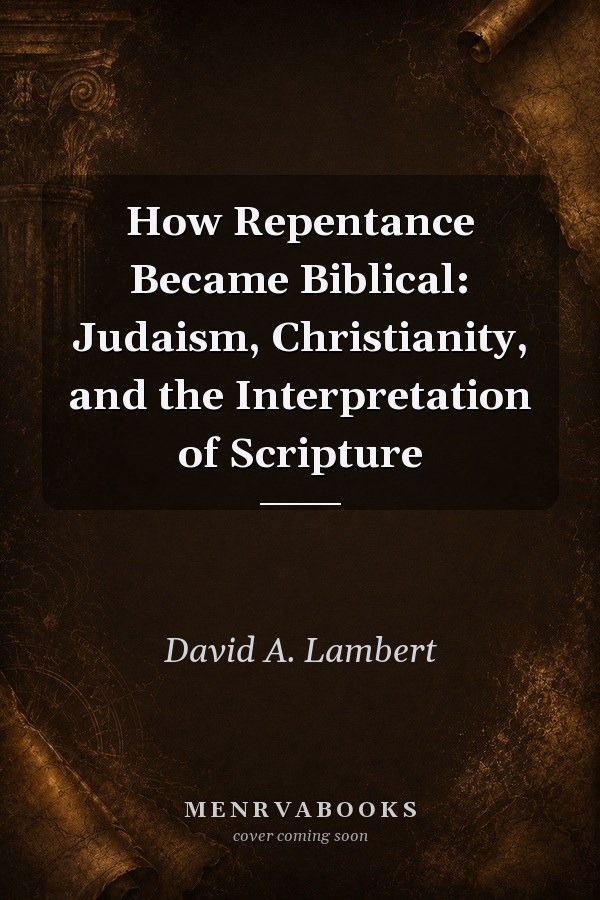
How Repentance Became Biblical: Judaism, Christianity, and the Interpretation of Scripture
0
0
As an Amazon Associate and affiliate partner, Menrva Books earns from qualifying purchases. Learn more
Author Description
Winner of the AAR's 2016 Award for Excellence in the Study of Religion: Textual StudiesHow Repentance Became Biblical tells the story of repentance as a concept. Many today, in both secular and religious contexts, assume it to be a natural and inevitable component of our lives. But, where did it originate? How did it become so prominent within Western religious traditions and, by extension, contemporary culture? What purposes does it serve? The book identifies repentance as a product of the Hellenistic period, where it was taken up within emerging forms of Judaism and Christianity as a mode of subjective control. It argues that, along with the rise of repentance, a series of interpretive practices, many of which remain in effect to this day, was put into place whereby repentance is read into the Bible and the Bible, especially the Hebrew Bible, or Old Testament, comes to be seen as repentance's source. Ancient Israelite rituals, such as fasting, prayer, and confession, all of which are incorporated later on within various religious communities as forms of penitential discipline, are understood as external signs of internal remorse. Hebrew terms and phrases, such as the prophetic injunction to "return to YHWH," are read as ancient representations of the concept, repentance. Prophetic literature as a whole is seen as serving a pedagogical purpose, as aiming at the reformation of Israel as a nation. Furthermore, it is assumed that, on the basis of the Bible, sectarians living in the late Second Temple period, from the Dead Sea sect to the early Jesus movement, believed that their redemption depended upon their repentance. In fact, the penitential framework within which the Bible is interpreted tells us the most about our own interpretive tendencies, about how we privilege notions of interiority, autonomy, and virtue. The book develops other frameworks for explaining the biblical phenomena in their ancient contexts, based on alternative views of the body, power, speech,
Menrva's Summary
THE THESIS
This book investigates the historical origins of repentance as a central religious concept, questioning how it became an assumed, inevitable component of Western religious tradition. David A. Lambert, a scholar of religious studies, utilizes a rigorous historical and philological framework to challenge the assumption that repentance is an inherent biblical theme. He argues that the concept emerged during the Hellenistic period as a mechanism for subjective control, subsequently shaping how later generations interpreted the Hebrew Bible to retroactively validate penitential practices.
THE SCOPE MAP
What You Will Find
- Analysis of Hellenistic-era religious developments in Judaism and Christianity.
- Examination of how ancient Israelite rituals like fasting and prayer were recontextualized as internal remorse.
- Critique of modern interpretive tendencies that prioritize interiority and autonomy when reading scripture.
Scope Limits
- The study does not provide a comprehensive history of all penitential practices across every global religious tradition.
- It does not offer a theological defense or critique of repentance as a spiritual practice, focusing instead on its historical and interpretive construction.
THE AUTHORITY PERSPECTIVE
Scholars and critics recognize this work as a significant contribution to the study of religion, evidenced by its receipt of the AAR Award for Excellence in the Study of Religion. Readers frequently note the academic density of the prose and the author's meticulous approach to textual interpretation.
Page Count:
280
Publication Date:
2015-01-01
Publisher:
Oxford University Press
ISBN-10:
019049333X
ISBN-13:
9780190493332
Religion
History
Repentance
Christianity
Bibles
Theology
Judaism
Cultural History
Bible
Community Tags
Other Editions(2)
Similar Books












Reader Comments
Share Your Thoughts
No comments yet. Be the first to share your thoughts!