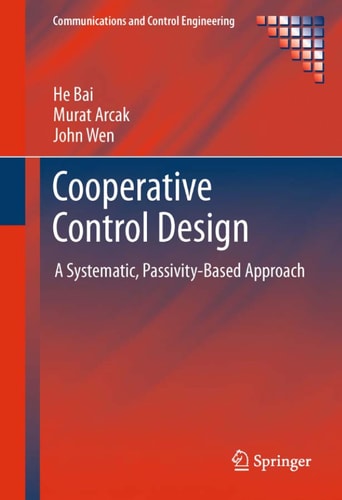
Cooperative Control Design
0
0
As an Amazon Associate and affiliate partner, Menrva Books earns from qualifying purchases. Learn more
Author Description
Cooperative Control Design: A Systematic, Passivity-Based Approach discusses multi-agent coordination problems, including formation control, attitude coordination, and synchronization. The goal of the book is to introduce passivity as a design tool for multi-agent systems, to provide exemplary work using this tool, and to illustrate its advantages in designing robust cooperative control algorithms. The discussion begins with an introduction to passivity and demonstrates how passivity can be used as a design tool for motion coordination. Followed by the case of adaptive redesigns for reference velocity recovery while describing a basic design, a modified design and the parameter convergence problem. Formation control is presented as it relates to relative distance control and relative position control. The coverage is concluded with a comprehensive discussion of agreement and the synchronization problem with an example using attitude coordination.
Menrva's Summary
THE THESIS
This book introduces passivity as a systematic design tool for multi-agent coordination problems. It aims to provide exemplary work using this tool, illustrating its advantages in designing robust cooperative control algorithms for applications such as formation control, attitude coordination, and synchronization. The authors begin by defining passivity and demonstrating its application in motion coordination, followed by discussions on adaptive redesigns for reference velocity recovery. The text concludes with a comprehensive examination of agreement and synchronization problems, including an example of attitude coordination.
THE SCOPE MAP
- Introduction to passivity as a design tool for multi-agent systems.
- Exemplary applications of passivity in motion coordination.
- Adaptive redesigns for reference velocity recovery.
- Detailed discussion of formation control, including relative distance and position control.
- Comprehensive coverage of agreement and synchronization problems.
- Example of attitude coordination to illustrate synchronization concepts.
THE AUTHORITY PERSPECTIVE
The book is structured to systematically introduce and apply passivity-based control for multi-agent systems. Its approach focuses on providing a clear design methodology with practical examples, suggesting it is aimed at researchers and engineers working in control systems and robotics. The detailed coverage of specific coordination problems like formation control and synchronization indicates a thorough treatment of the subject matter.
Page Count:
210
Publication Date:
2011-06-03
Publisher:
Springer Nature
ISBN-10:
1461400147
ISBN-13:
9781461400141
Non-Fiction
Science
Systems Theory
Control systems
Engineering
Robotics
Community Tags
Similar Books