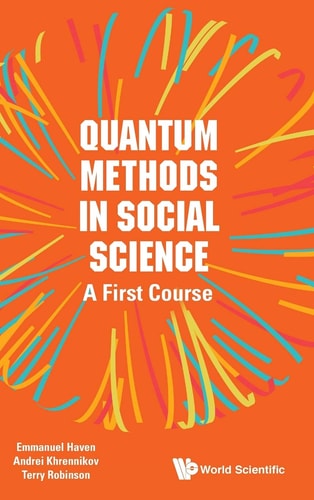
Quantum Methods in Social Science: A First Course
0
0
As an Amazon Associate and affiliate partner, Menrva Books earns from qualifying purchases. Learn more
Author Description
Shown here is how basic concepts of physics can be used to improve models in finance, economics, psychology and biology. Readers are introduced to how physical theory can inform non-physical phenomena in the social sciences, thereby improving decision making and modeling capabilities in research-based and professional settings.Consisting of three parts, the first part deals with the application of quantum operator methods to financial transactions and population dynamics. Part two develops physical concepts, working from classical Lagrangian and Hamiltonian mechanics and leading to an introduction of quantum information and its application to decision making. The final part treats classical and quantum probability theory in some detail and deals, at a more advanced level, with the impact of quantum probabilities on common knowledge and common beliefs between agents in systems.Quantum Methods in Social Science is a high level textbook for advanced undergraduate or graduate students of economics, finance and business, while also being of interest to those with a background in physics.
Menrva's Summary
THE THESIS
This book investigates how fundamental concepts from physics, particularly quantum mechanics, can be applied to enhance modeling and decision-making in various social science disciplines. It introduces readers to the application of quantum operator methods in finance and population dynamics, develops physical concepts from classical mechanics to quantum information, and explores the impact of quantum probabilities on common knowledge and beliefs among agents. The work aims to bridge the gap between physical theory and non-physical phenomena, thereby improving research and professional modeling capabilities.
THE SCOPE MAP
- Application of quantum operator methods to financial transactions.
- Application of quantum operator methods to population dynamics.
- Development of physical concepts from classical Lagrangian and Hamiltonian mechanics.
- Introduction to quantum information and its application to decision making.
- Detailed treatment of classical and quantum probability theory.
- Advanced discussion on the impact of quantum probabilities on common knowledge and beliefs between agents.
THE AUTHORITY PERSPECTIVE
This textbook is designed for advanced undergraduate or graduate students in economics, finance, and business, and is also of interest to those with a physics background. The structure progresses from foundational physics concepts to their application in social sciences, suggesting a rigorous and interdisciplinary approach. The content covers advanced topics such as quantum information and probability theory, indicating a specialized and potentially challenging read for its target audience.
Page Count:
276
Publication Date:
2017-01-01
Publisher:
World Scientific
ISBN-10:
1786342766
ISBN-13:
9781786342768
Economics
Psychology
Science
Non-Fiction
Probability Theory
Finance
Biology
Decision Making
Community Tags
Similar Books