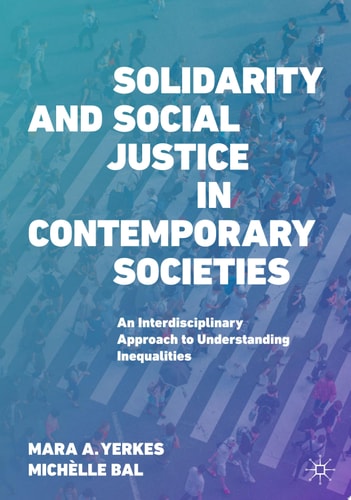
Solidarity and Social Justice in Contemporary Societies
0
0
As an Amazon Associate and affiliate partner, Menrva Books earns from qualifying purchases. Learn more
Author Description
This textbook will familiarize readers with some of the most pressing solidarity and social justice issues in contemporary societies. Ongoing and emerging inequalities along the lines of gender, age, socio-economic status, ethnic background, and sexual orientation challenge the solidarity underlying societies, resulting in complex questions of social justice. Moreover, several global challenges, such as digitalization, climate change, and the COVID-19 pandemic challenge solidarity and social justice in new ways. How do societies respond to these enduring, growing or changing inequalities? Do these challenges lead to an expansion or an erosion of solidarity, in an 'us versus them' rhetoric? And to what extent do societies differ in their social justice values and hence the acceptance of social inequality? Taking a sociological, psychological, and political philosophical approach to these topics, this book offers state-of-the art theoretical and empirical contributions from globally-recognized scholars in sociology, psychology, and political philosophy, providing a unique interdisciplinary approach to understanding solidarity and social justice in response to social inequalities in contemporary European societies.
Menrva's Summary
THE THESIS
This textbook examines the complex interplay of solidarity and social justice in contemporary societies, focusing on how various inequalities challenge societal cohesion. The authors, drawing on sociological, psychological, and political philosophical perspectives, explore how gender, age, socio-economic status, ethnic background, and sexual orientation contribute to enduring and emerging inequalities. The book investigates societal responses to these challenges, questioning whether they lead to an expansion or erosion of solidarity and how different societies navigate social justice values and the acceptance of inequality. It presents state-of-the-art theoretical and empirical contributions from leading scholars, offering an interdisciplinary approach to understanding these critical issues in contemporary European societies.
THE SCOPE MAP
- Analysis of inequalities based on gender, age, socio-economic status, ethnic background, and sexual orientation.
- Exploration of global challenges such as digitalization, climate change, and the COVID-19 pandemic and their impact on solidarity.
- Sociological, psychological, and political philosophical theoretical frameworks.
- Empirical contributions from recognized scholars in sociology, psychology, and political philosophy.
- Focus on contemporary European societies.
- Discussion on the expansion or erosion of solidarity and the rhetoric of 'us versus them'.
- Examination of societal differences in social justice values and acceptance of inequality.
THE AUTHORITY PERSPECTIVE
This textbook is designed to provide readers with a comprehensive understanding of pressing solidarity and social justice issues in contemporary societies. It synthesizes theoretical and empirical contributions from diverse academic fields, offering an interdisciplinary perspective on complex social inequalities. The book aims to equip readers with the knowledge to analyze how societies respond to enduring and emerging challenges to social cohesion. Its approach is intended to foster critical thinking about the dynamics of solidarity and the varying acceptance of social inequality across different cultural and political contexts.
Page Count:
223
Publication Date:
2022-04-25
Publisher:
Springer Nature
ISBN-10:
303093795X
ISBN-13:
9783030937959
Politics
Psychology
Non-Fiction
Political Philosophy
Sociology
Social justice
Community Tags
Similar Books