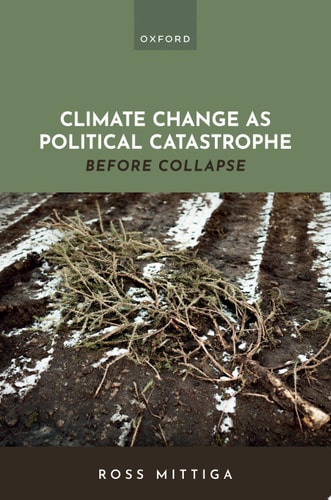
Climate Change as Political Catastrophe: Before Collapse
0
0
As an Amazon Associate and affiliate partner, Menrva Books earns from qualifying purchases. Learn more
Author Description
There is now clear scientific consensus that, without immediate and decisive action, the world risks climate catastrophe. This has fueled climate emergency declarations among activist groups and, increasingly, among local, state, and supranational governments. But what exactly counts as a "climate catastrophe" and what does catastrophic climate change portend for contemporary societies?This book argues that climate change is politically catastrophic insofar as it threatens to undermine the material conditions that make justice - and by extension stable democratic government - possible. It then uses the lens of catastrophe to bring into focus pressing questions concerning how to navigate trade-offs between fairness and precautionary efficacy in the design of climate policy, the permissibility of authoritarian climate emergency powers, and the nature and role of climate disobedience.Apart perhaps from the spectre of nuclear annihilation, human civilization has never had to reckon with a threat so final and encompassing as that of climate catastrophe. Much as some have argued that "supreme necessity" alters the contours of what is permissible in war, this book starts from the premise that the credible threat of politically catastrophic climate change upends many of the most basic and widely shared assumptions in liberal and democratic thought.
Menrva's Summary
THE THESIS
This book investigates how the threat of climate change functions as a political catastrophe that undermines the material conditions necessary for justice and democratic stability. Ross Mittiga, a scholar of political theory, utilizes the framework of political catastrophe to examine the tension between democratic norms and the urgent requirements of climate action. He argues that the existential nature of climate change necessitates a re-evaluation of liberal democratic assumptions regarding state power, policy design, and the legitimacy of civil disobedience.
THE SCOPE MAP
What You Will Find
- A theoretical framework defining climate change as a political catastrophe.
- Analysis of the trade-offs between fairness and precautionary efficacy in climate policy.
- Ethical evaluation of authoritarian emergency powers in response to climate threats.
- Examination of the role and moral status of climate-related civil disobedience.
Scope Limits
- The text does not provide specific technical climate modeling or scientific data sets.
- It does not offer a comprehensive policy manual for local government implementation.
THE AUTHORITY PERSPECTIVE
Scholars in political theory view this work as a significant contribution to the intersection of environmental ethics and democratic governance. Readers frequently note the academic density of the prose, which is intended for audiences familiar with political philosophy and normative theory.
Page Count:
160
Publication Date:
2024-01-01
Publisher:
Oxford University Press
ISBN-10:
019286887X
ISBN-13:
9780192868879
Philosophy
Politics
Climate Change
Political Philosophy
Ethics
Democracy
Climatology
Community Tags
Similar Books