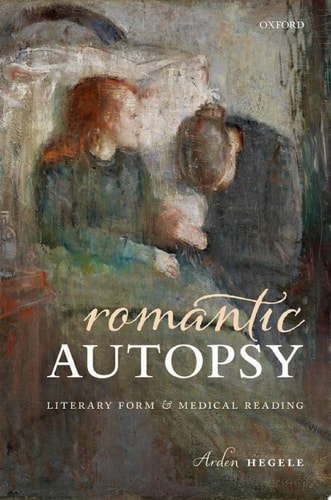
Romantic Autopsy: Literary Form and Medical Reading
0
0
As an Amazon Associate and affiliate partner, Menrva Books earns from qualifying purchases. Learn more
Author Description
Today, we do not expect a symptomatic reading to refer to bodily symptoms, or a literary dissection to be more than metaphorical. But this was not always true. In Romantic Autopsy, Arden Hegele considers a moment at the turn of the nineteenth century, when literature and medicine seemed embattled in rivalry, to find that the two fields collaborated to develop interpretive analogies that saw literary texts as organic bodies and anatomical features as legible texts. Together, Romantic readers and doctors elaborated protocols of diagnosis-practices for interpretation that could be used to diagnose disease, and to understand fiction and poetry. This volume puts essential works of British Romantic literature that seem at first to have little to do with medicine, such as the lyrics of William Wordsworth, the elegies of Percy Shelley and Alfred Tennyson, and the novels of Mary Wollstonecraft, Jane Austen, and Mary Shelley, back into conversation with emergent medical disciplines of the period -- anatomy, pathology, psychiatry, and semiology. Poems and novels, Hegele argues, were historically understood through techniques designed for the analysis of disease; meanwhile, autopsy reports and case histories adopted stylistic features associated with literature. Countering the assumption of a growing specialization in Romanticism, these practices suggest that symptomatic reading (treating a text's superficial signs as evidence of deeper meaning), a practice still used and debated today, might have originated from Romantic diagnostics. The first study of the interconnected literary and medical analytics of British Romanticism, Romantic Autopsy charts an important history underlying our own approaches to literary analysis.
Menrva's Summary
THE THESIS
This book investigates the historical intersection between medical diagnostic practices and literary interpretation during the British Romantic period. Arden Hegele, a scholar in the medical humanities, examines how the development of anatomy, pathology, and semiology influenced the way nineteenth-century readers approached poetry and prose. By analyzing the cross-pollination of these fields, the author argues that modern symptomatic reading—the practice of treating textual signs as evidence of hidden meaning—finds its origins in the diagnostic protocols of Romantic-era medicine.
THE SCOPE MAP
What You Will Find
- Analysis of British Romantic literature including works by Wordsworth, Shelley, and Austen
- Historical examination of medical disciplines such as anatomy, pathology, and psychiatry
- Exploration of the stylistic overlap between medical case histories and literary narratives
- Theoretical framework for understanding symptomatic reading as a shared interpretive practice
Scope Limits
- The study focuses primarily on British Romanticism and does not extend into contemporary clinical medical practice or modern diagnostic technology.
THE AUTHORITY PERSPECTIVE
Scholars in the field of medical humanities recognize this work as a significant contribution to understanding the interdisciplinary roots of literary analysis. Readers frequently note the academic density of the prose, which provides a rigorous historical foundation for those interested in the evolution of critical theory.
Page Count:
233
Publication Date:
2021-01-01
Publisher:
OUP Oxford
ISBN-10:
0192664468
ISBN-13:
9780192664464
Literary Criticism
British literature
Romanticism
Academic
English & College Success
English
Medicine history
English literature
Community Tags
Similar Books