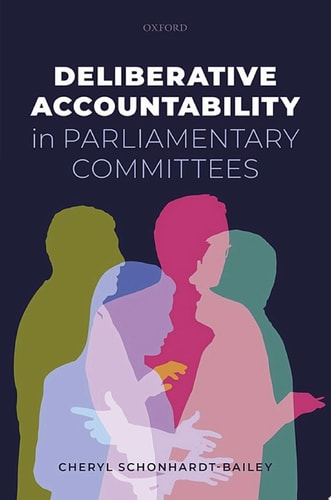
Deliberative Accountability in Parliamentary Committees
0
0
As an Amazon Associate and affiliate partner, Menrva Books earns from qualifying purchases. Learn more
Author Description
In recent decades, we have seen an explosion in expectations for greater accountability of public policymaking. But, as accountability has increased, trust in governments and politicians has fallen. By focusing on the heart of public accountability--the reason-giving by policymakers for their policy decisions (i.e. deliberative accountability)--this work offers an empirical route for understanding why more accountability may not always deliver more public trust. The focus is on the British Parliament, where both the Treasury Select Committee and the House of Lords Economic Affairs Committee hold hearings on monetary policy, financial stability, and fiscal policy. The intent in these hearings is to challenge policymakers to explain their decisions, and thus the dialogue is expected to be deliberative. But how do we judge the quality of this deliberative accountability? Three metrics are explored and measured: respect, non-partisanship, and reciprocity. The approach is multi-method, including (1) quantitative text analysis to gauge the verbatim transcripts in committee hearings; (2) qualitative coding combined with an experimental design to gauge the role of nonverbal communication in the hearings; and (3) interviews with the MPs, peers, central bankers, and Treasury officials who participated in the hearings. The first method measures the content of 'what' was said, the second examines 'how' the words and arguments were expressed, and the third provides a more reflective 'why' component by asking participants to explain their motivations. This merging of the 'what', the 'how', and the 'why' offers a novel template for studying both accountability and deliberation.
Menrva's Summary
THE THESIS
This work investigates the paradox of why increased institutional accountability in public policymaking has failed to generate a corresponding rise in public trust. Author Cheryl Schonhardt-Bailey examines the British Parliament, specifically the Treasury Select Committee and the House of Lords Economic Affairs Committee, to analyze the quality of deliberative accountability. By evaluating reason-giving as the core of democratic oversight, the book proposes that the effectiveness of accountability depends on specific communicative metrics rather than just the frequency of oversight activities.
THE SCOPE MAP
What You Will Find
- Quantitative text analysis of verbatim transcripts from parliamentary committee hearings.
- Qualitative coding and experimental design focused on nonverbal communication cues.
- Primary source interviews with Members of Parliament, peers, central bankers, and Treasury officials.
- A three-part framework measuring respect, non-partisanship, and reciprocity in political dialogue.
Scope Limits
- The analysis is restricted to the British Parliament and specifically focuses on monetary, financial, and fiscal policy committees.
- The study does not address broader electoral accountability or non-parliamentary forms of government oversight.
THE AUTHORITY PERSPECTIVE
Scholars in political science and legislative studies identify this work as a rigorous methodological template for analyzing deliberative quality in institutional settings. Experts frequently note the book's success in bridging quantitative text analysis with qualitative interview data to provide a comprehensive view of parliamentary dynamics.
Page Count:
396
Publication Date:
2022-01-01
Publisher:
OUP Oxford
ISBN-10:
0192663720
ISBN-13:
9780192663726
Economics
Legislative bodies committees
Parliamentary Studies
Communication Studies
Public Policy
Government accountability
Community Tags
Similar Books