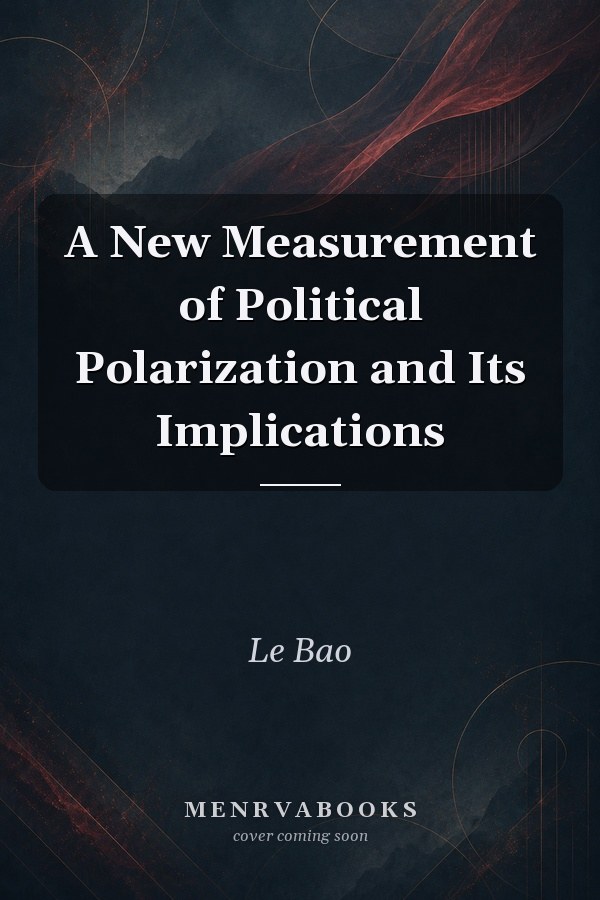
A New Measurement of Political Polarization and Its Implications
0
0
As an Amazon Associate and affiliate partner, Menrva Books earns from qualifying purchases. Learn more
Author Description
The past decade witnessed growing scholarly interest in mass polarization and concerns that divided electorates around the world are pulling political systems apart. However, comparative studies of mass polarization are limited by the lack of appropriate research methods and scholarly debate remains with regard to what causes mass polarization and whether countries are indeed ideologically more polarized. The dissertation consists of three chapters on the methods of studying polarization and their implications. Chapter 1 focuses on the measurement issue of mass polarization. We propose a new nonparametric, entropy-based measure of mass polarization that is theoretically and conceptually more appropriate for the intuition and structure of polarization. It exploits the specific structure of ordinal distributions and is able to capture both the ordering and distribution in public opinion data. The analytical comparisons, simulation, and empirical examples all demonstrate the reliability of the proposed measure and its capability of revealing the nuanced and complicated dynamics of polarization. Chapter 2 introduces a compositional data analysis approach to study macro-level political behavior. We show that log-ratio transformation, especially isometric log-ratio transformation, is more methodologically appropriate for compositional data, and further provides the leverage for exploring the richer underlying dynamics between different compositional parts. We use Monte Carlo simulations and a real-world example of democratic support to compare the proposed method with conventional political behavior approaches. Chapter 3 applies the preceding methods to the pressing question of how socio-economic inequality impacts mass polarization. We argue that, with increasing inequality, the growing lower class is the primary cause of mass polarization. We also consider party polarization and group-based redistribution as two possible moderation mechanisms that influence the relation
Menrva's Summary
THE THESIS
This dissertation investigates the complex issue of political polarization by proposing novel measurement techniques and analyzing its relationship with socio-economic inequality. The author addresses the limitations of existing comparative studies on mass polarization, which are often hampered by inadequate research methods and a lack of consensus on the drivers and extent of ideological division. Through three chapters, the work introduces a new entropy-based measure for polarization, explores compositional data analysis for macro-level political behavior, and applies these methods to examine how socio-economic inequality, particularly the growth of the lower class, fuels mass polarization, with potential moderating roles for party polarization and group-based redistribution.
THE SCOPE MAP
- A new nonparametric, entropy-based measure for quantifying mass political polarization.
- Methodological framework for analyzing compositional data in political behavior studies, including log-ratio transformations.
- Application of proposed methods to real-world data on democratic support.
- Analysis of the impact of socio-economic inequality on mass polarization.
- Argument that increasing inequality, driven by the lower class, is a primary cause of mass polarization.
- Consideration of party polarization and group-based redistribution as moderating factors.
THE AUTHORITY PERSPECTIVE
The work presents a rigorous methodological approach to understanding political polarization, offering a novel measure that aims to capture the nuances of ordinal distributions in public opinion data. By integrating compositional data analysis, the dissertation provides advanced tools for macro-level political behavior research, demonstrated through simulations and empirical examples. The application to socio-economic inequality suggests a clear causal link, identifying the growing lower class as a significant driver of polarization, which is a key contribution to the ongoing scholarly debate. The research is positioned to inform future studies on the dynamics of divided electorates and the structural factors contributing to political division.
Page Count:
178
Publication Date:
2022-01-01
Publisher:
American University
ISBN-13:
9798351479569
Politics
Economics
Non-Fiction
Sociology
Research Methods
Community Tags
Similar Books