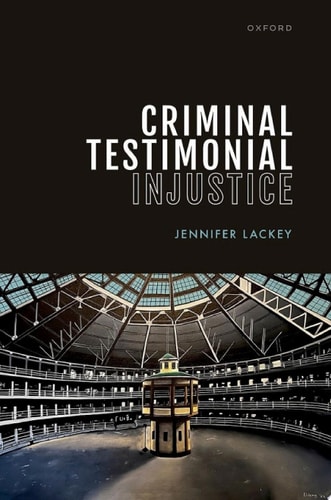
Criminal Testimonial Injustice
0
0
As an Amazon Associate and affiliate partner, Menrva Books earns from qualifying purchases. Learn more
Author Description
Through a detailed analysis that draws on work across philosophy, the law, and social psychology, Criminal Testimonial Injustice shows that, from the very beginning of the American criminal legal process in interrogation rooms to its final stages in front of parole boards, testimony is extracted from individuals through processes that are coercive, manipulative, or deceptive. This testimony is then unreasonably regarded as representing the testifiers' truest or most reliable selves. With chapters ranging from false confessions and eyewitness misidentifications to recantations from victims of sexual violence and expressions of remorse from innocent defendants at sentencing hearings, it is argued that there is a distinctive epistemic wrong being perpetrated against suspects, defendants, witnesses, and victims. This wrong involves brute State power targeting the epistemic agency of its citizens, extracting false testimony that is often life-shattering, and rendering the victims in question complicit in their own undoing. It is concluded that it is only through understanding what it means to respect the epistemic agency of each participant in the criminal legal system that we can truly grasp what justice demands and, in so doing, to reimagine what is possible.
Menrva's Summary
THE THESIS
This book investigates the systemic epistemic wrongs perpetrated within the American criminal legal system when state power extracts and relies upon coerced or deceptive testimony. Jennifer Lackey, a professor of philosophy, synthesizes research from legal studies, social psychology, and epistemology to argue that the state undermines the epistemic agency of citizens. She posits that the reliance on testimony obtained through manipulation—from interrogation rooms to parole hearings—results in profound injustices that implicate the testifiers in their own legal undoing.
THE SCOPE MAP
What You Will Find
- Analysis of false confessions and eyewitness misidentifications
- Examination of recantations from victims of sexual violence
- Study of remorse expressions during sentencing hearings
- Philosophical framework regarding epistemic agency and state power
Scope Limits
- The text focuses primarily on the American criminal legal system
- It does not provide a comprehensive history of global legal practices
THE AUTHORITY PERSPECTIVE
Scholars and legal theorists identify this work as a significant contribution to the intersection of philosophy and criminal justice. Readers frequently note the rigorous academic density of the prose and its effectiveness in challenging standard assumptions about the reliability of legal testimony.
Page Count:
222
Publication Date:
2023-01-01
Publisher:
OUP Oxford
ISBN-10:
0192679031
ISBN-13:
9780192679031
Philosophy
Sociology
Laws of Specific jurisdictions
United States
Witnesses
Law
Administration of Justice
Epistemology
Community Tags
Similar Books