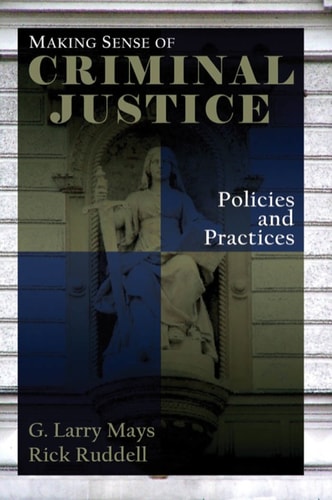
Making Sense of Criminal Justice: Policies and Practices
0
0
As an Amazon Associate and affiliate partner, Menrva Books earns from qualifying purchases. Learn more
Author Description
As they learn about the criminal justice system, students often hear that "nothing works." Enter Making Sense of Criminal Justice--an innovative and insightful textbook that meets the needs of both criminal justice policy courses and undergraduate capstone courses (sometimes called "senior seminars"). Beginning with an outline of the crime control and due process models, G. Larry Mays and Rick Ruddell have organized the book around the three major components of the criminal justice system (police, courts, and corrections). This topical, issues-oriented approach encourages students to think critically about major dilemmas faced by participants in the system, from issues of race and gender to the use of the death penalty.Working from a balanced viewpoint, the authors argue that criminal justice is inherently a political process; they examine strategies that work, those that do not work, and those that represent a gray area between the two extremes. Rather than providing students with "the answers," Mays and Ruddell challenge them to think critically about how we deal with situations--such as the use of force by the police--and offer a framework for lively classroom discussions and debates.End-of-chapter key terms, critical-thinking review questions, and recommended readings enhance students' understanding of the material and aid in test preparation.
Menrva's Summary
THE THESIS
This text investigates the efficacy of criminal justice policies by challenging the pervasive notion that systemic reform is impossible. Authors G. Larry Mays and Rick Ruddell, both established scholars in the field, utilize a political framework to analyze the interactions between police, courts, and corrections. They argue that criminal justice is an inherently political process, requiring students to evaluate strategies based on empirical outcomes rather than ideological assumptions.
THE SCOPE MAP
What You Will Find
- Analysis of the crime control versus due process models.
- Examination of the three primary pillars: police, courts, and corrections.
- Discussion of systemic dilemmas including race, gender, and capital punishment.
- Pedagogical tools such as key terms, review questions, and recommended readings.
THE AUTHORITY PERSPECTIVE
Instructors frequently utilize this text as a foundational resource for undergraduate capstone courses due to its balanced, issues-oriented approach. Experts note that the prose is accessible for students while maintaining the academic rigor necessary for critical policy analysis.
Page Count:
368
Publication Date:
2007-03-30
Publisher:
Oxford University Press
ISBN-10:
019533244X
ISBN-13:
9780195332445
Sociology
United States
Law
Administration of Justice
textbook
Community Tags
Similar Books